navigation

June 6, 2022

Windy Season, By Eve Morton


On the first day of Windy Season, Mina woke at dawn. The house was already filled with life. Her mother boiled water in the kitchen, the hiss of steam matching the clattering of the wind against her window pane. Her brothers whispered in the room beside hers, the walls thin as the skin over their bones.

"When the North Wind wakes, He carries a large sword," Vincent said, reciting the chant her family had spoken for years. "He cuts down the trees so the seeds will spread and circle the globe, making new life and forms."


"Then the West Wind carries a large spoon to stir the waves," Samuel added, his voice reedy like the wind through the chimney. "He scoops up the pearls, the fish, the whales, and sweeps what we need onto the shore, to eat and rejoice."


"Then the South Wind swallows the land whole. He kicks up dust and makes a fuss so we can see our better selves."


"While the East Wind listens close for the ghosts of last year's sadness, and He gives them back to the land. So it can start again."


"So it can start again," Vincent echoed.


Mina repeated the final line for herself, "So it can start again."


Then she let out a long breath, like she knew each of her brothers was doing, pretending to be the wind.


Mina listened as her brothers scrambled into the kitchen, greeted their mother, and began breakfast. Though Windy Season would last another three months, allowing the dirt, crops, and landscape to change all around them, the first day was special. And while Mina had longed for this moment, she was also afraid.


After breakfast and a reading from their grimoire, the family would gather the ashes of the dead. Last year, it was their dog, Sanders. The year before that, there had been no dead, only dried flower petals used as a substitute in order to say Thank You to the spirits for keeping them hale and fit. A different year, there was another dog, Mackenzie. Before that, a stray cat, a calf, and a fox that her father had accidentally killed. Then Mina's memory became fuzzy, like sand grains or snow squalls against a window.


This year it was her father in the clay vessel on their mantelpiece. It was he, Jordan Sullivan, who would be released into the wind the first day of Windy Season, so he could begin his long travel to the land of the dead with the help of the four cardinal directions.


Like all the deceased in their village, man or animal alike, Jordan had been cremated shortly after death. That had been six months ago, when a flu gripped his chest and not let go. The death midwife, a woman named Bea, delivered the ashes to them and stayed for a celebratory dinner, where they spoke about Jordan Sullivan's life. Though long ago now, Mina was still sure she could smell the venison, cooked potatoes and other root vegetables, and the flowery scent of the death midwife in the air. Mina had been silent during that dinner, only speaking a handful of words about her father--good man, I loved him--and her mother had been saddened.


"You are the oldest," she chastised once the death midwife was gone and the ashes of her father remained on the mantelpiece, waiting for Windy Season. "You need to set an example."


Mina had taken her lashings and apologized. But she'd also remained quiet, aloof, in the background, a shadow for the following six months.


No more. Now that Windy Season had truly begun, she believed she could sing her father into absolution, leading him to his first stop on the journey of the dead.


"Well," her mother said, once Mina had joined them at the table. "Look who finally showed up."


Mina ate in silence. Her brothers sang their song, and though it moved their mother to tears, she didn't ask them to stop. Once the dishes were cleaned, they gathered their Windy Season gear: goggles, bandanas, and long clothing though the heat of the day would grow. The wind whipped against the house, clattering the windows, and making the chimney scream out.


Mina grabbed her father's ashes. When her mother challenged her, she simply said, "Please."


"If you're sure, then." Her mother held the door open, her knuckles white against the fierce winds. "Hurry. We do not have much time."


The four of them assembled on their front lawn. Trees bent in all directions; all grasses were flattened; and beyond their hands, nothing was visible. Mina licked a finger to check directions, but it was soon caked with dust. Her bandana stood up straight, as if attacked from all sides. She didn't know what direction her father was to begin.


"Hurry!" her mother cried. "He cannot wait another year."


Mina surveyed the vast horizon. There was no sense of direction, no opening her father could ride to his final resting place. Nothing to see or hold onto.


Vincent began to sing. Samuel followed. Their voices warbled, but not with sadness. Their words were plucked by the wind, steering the directions according to the song. When her mother joined in, the directions grew stronger. Mina sang too, the wind following all their voices in tune.


At the final verse, Mina opened her father's ashes. They exploded like sparks on a lit fuse, like fireworks from another time period, distant and foreign. The wind took the ashes and held a body in place. A man, a shadow. Perfect.


Then he was gone.


Her family cried, tears mixing with dirt and making mud on their cheeks. They sobbed for their lost father, their husband, a man named Jordan Sullivan, who was now part of the earth, ready to fly towards his rightful place in the land of the dead.


"So it can start again," Mina said.


"So it can start again," the wind echoed back.

Eve Morton is a writer living in Ontario, Canada. She teaches university and college classes on media studies, academic writing, and genre literature, among other topics. Her poetry book, Karma Machine, was released in late 2020. Find more info on authormorton.wordpress.com


Cover: Amanda Bergloff

Twitter @AmandaBergloff

Instagram: amandabergloff 

The Queen's Temple, By Alexander Etheridge


There’s a scorpion in your mind,

and vast fires in

your eye.

The sun went down

ten thousand years ago, its light fell

into a swallowing dark.  

Listen to the bell

ringing over a mass grave,

hear your heart stop in an ocean 

of silence.

Hear an absolute

absence, there where a frigid blue

sinks into the forest.

Hear the bell stop, watch the fox

and the lamb fall into black shadows.

Was it in this misty world

where you first touched the face

of grief?  Do you remember

those closed eyes, 

and that first wave of cold rain?

One vision bled into the next—

the first dream wove with a dark thread 

a death mask for the final 

dream . . . it was there 

that you were born into 

blind hungers and stark prayers,

and it was there where you set out to find

a hidden path up the mountain

to the Queen of Birds in her 

ancient temple, where beauty’s 

word, one perfect word,

lights the dusky chambers.

Alexander Etheridge has been developing his poems and translations since 1998.  His poems have been featured in Wilderness House Literary Review, Ink Sac, Cerasus Journal, The Cafe Review, The Madrigal, Abridged Magazine, Susurrus Magazine, The Journal, and many others.  He was the winner of the Struck Match Poetry Prize in 1999.


Cover: Amanda Bergloff

Twitter @AmandaBergloff

Instagram: amandabergloff 

The Stone Sister, By Betty Stanton


A very long time ago a huntsman and his young wife lived in a small cottage by the forest. The huntsman and his wife wanted to have a child, but though they tried for many years, they remained childless. 


One day news came to them from a nearby village of a woman found living in a small cottage in the forest. This witch, for so she was called by the people of the village, could speak with the spirits of the dead during heavy rains and would grant favors to those who came to her in the wet dark. 


The huntsman begged his wife not to visit the witch. It was said that beyond the black forest there was a land of dead spirits, and that those who traveled there would be filled with dark and dangerous magic, but the wife was so overcome with her desire for a child that one morning when he was out hunting, and a heavy rain welled up suddenly in the sky, she traveled into the forest alone.


She came upon a small shamble of a cottage set around a willow tree so ancient and thick that the rain could not slip through its leaves. When the wife knocked at the door of the cottage, a gnarled woman answered, her body bent and twisted and her skin holding the pallor of death. 


The wife was nearly overcome with fear, but her desire was so great that she found herself being led into the cottage where the witch agreed to help the huntsman’s wife conceive a child. In return, the witch asked a promise of the young wife. She would have to give her word that when the witch came for her she would leave her family and travel to the land of the dead. 


The huntsman’s wife was grieved to make such a promise, but so great was her desire for a child that she agreed and left the witch’s cottage with a magical draught. She was surprised to find the heavy rain halted and sunshine slipping through the heavy canopy of leaves as she walked. That night, before her husband could ask what she had done, the wife drank the draught and took her husband to bed.


That very night they conceived a daughter and, overjoyed, the young wife forgot the promise she had made to the witch in the forest, but on the very night their daughter was born the rain welled up heavy and hard against the thatch of their cottage. That night, the witch arrived and forced the huntsman’s wife to keep their bargain. Leaving the newborn with its father, the wife left her family and traveled to the land of the dead, never to return.  


As the weeks passed the huntsman’s heart grew cold. He resented his newborn daughter. Her cries and needs. Her resemblance to his lost wife. One evening he woke to her cries and called out, “I wish you were a stone, and could be put out and forgotten.” Then he fed the child and returned to bed. When he woke in the morning there was a large round stone where his daughter had been. The huntsman sat the stone in the garden that had been his wife’s pleasure, and though he did not truly forget, the years that passed dulled the huntsman’s pain as it dulled his memory.   


Eventually the huntsman remarried, and with his second wife conceived a son who brought joy and warmth back to his father’s heart. When the boy was five years old, however, the huntsman’s new wife was also taken to the land of the dead. After her death, the huntsman grew afraid even of a light rain and locked his son inside their cottage, fearing that the world would take his one last pleasure.


The boy grew strong in the cottage, but he also grew very lonely with only his father as company. Many times he tried to escape. Through his window he could see the world outside, but he could only open the window enough to breathe in the clear air and never enough that his small body could fit through. Every day he would stare out his window to their little garden and the forest beyond and wish for friends to care for him.


One day during a light rain, while his father was out hunting, a pale and gnarled woman appeared at his window. Excited to see someone new, even if her visage was terrifying, the boy rushed to open the window wide to speak to her. To his surprise the woman only passed him a large stone through the open window. It was a stone from the garden, one that he had stared at many times but never really thought of.


“Make your wish upon the stone,” the woman said, “and you shall have someone to care for you.”


The boy, who had been warned about dangerous witches by his father, was wary, but his desire for a friend was so strong that as soon as the woman had gone, he sat the stone down on his small bed and wished for it to become a friend. Immediately the stone began to transform, and soon became his sister, now grown to a young woman.


When the huntsman returned home, he was met by his son and his daughter. At the sight of the young woman who now looked so much like his first young wife, the huntsman’s heart was overcome, and he begged to be forgiven. His daughter, rather than see him in such agony, only said; “I wish you were a raven, so that you could fly far from here to be again with those you have lost.”


Immediately, the huntsman was transformed into a raven. He flew from the open window and crossed the forest to the land of the dead, and when he had gone the stone-sister and her brother lived together in happiness.

Betty Stanton (she/her) is a writer who lives and works in Tulsa, Oklahoma. Her work has appeared or is forthcoming in various journals and collections and has been included in anthologies from Dos Gatos Press and Picaroon Poetry Press. She received her MFA from The University of Texas - El Paso.


Cover: Amanda Bergloff

Twitter @AmandaBergloff

Instagram: amandabergloff 

Lost and Found in the Rain, By Alicia Hilton


Hiking

through a forest preserve,

I tried to find myself

hiding in dappled shadows.


Hazy clouds 

veiled the sun,

unleashed icy drizzle.


A blue jay squawked,

berating me for trespassing

in his territory.


The mist thickened.


Raindrops

beat a staccato patter.


My teeth started to chatter,

but I was too stubborn

to turn back.


Down the hill I trod,

carefully stepping around

a mound of Artomyces pyxidatus

clinging to a downed log.


I stroked the lacy fungi,

so tasty when sautéed, 

but the coral crown

was too perfect to pluck.


An old pine tree bent and swayed,

whispering, this way.


Pinus strobus pointed at a creek.

Her branches clacked, 

a swift jab in my back.


The needles tickled,

but I dared not laugh.


All forest adventurers

should respect nature,

especially trees, so regal.


I crept closer.


Wet moss smelled like mysteries.


Water gurgled over rocks,

saying, come and play.


I shed my boots,

socks and inhibitions.


Algae made the creek bed slick.

Bracing cold

swirled around

my toes.


Foam formed a face.

The Nereid demanded

that I dance.


Dumbstruck, I swayed.


Dance, she commanded.


Geese flying overhead

cocked their heads

and honked

while I pranced.


I spun in a circle

and fell on my ass.


The Nereid vanished,

but I heard her 

laughing with me.

Alicia Hilton believes in angels and demons, magic, and monsters. Her work has appeared in Daily Science Fiction, Enchanted Conversation, Modern Haiku, Neon, Unnerving, Vastarien, Year’s Best Hardcore Horror Volumes 4, 5 & 6, and elsewhere. Her website is https://www.aliciahilton.com. Follow her on Twitter @aliciahilton01.


Cover: Amanda Bergloff

Twitter @AmandaBergloff

Instagram: amandabergloff 

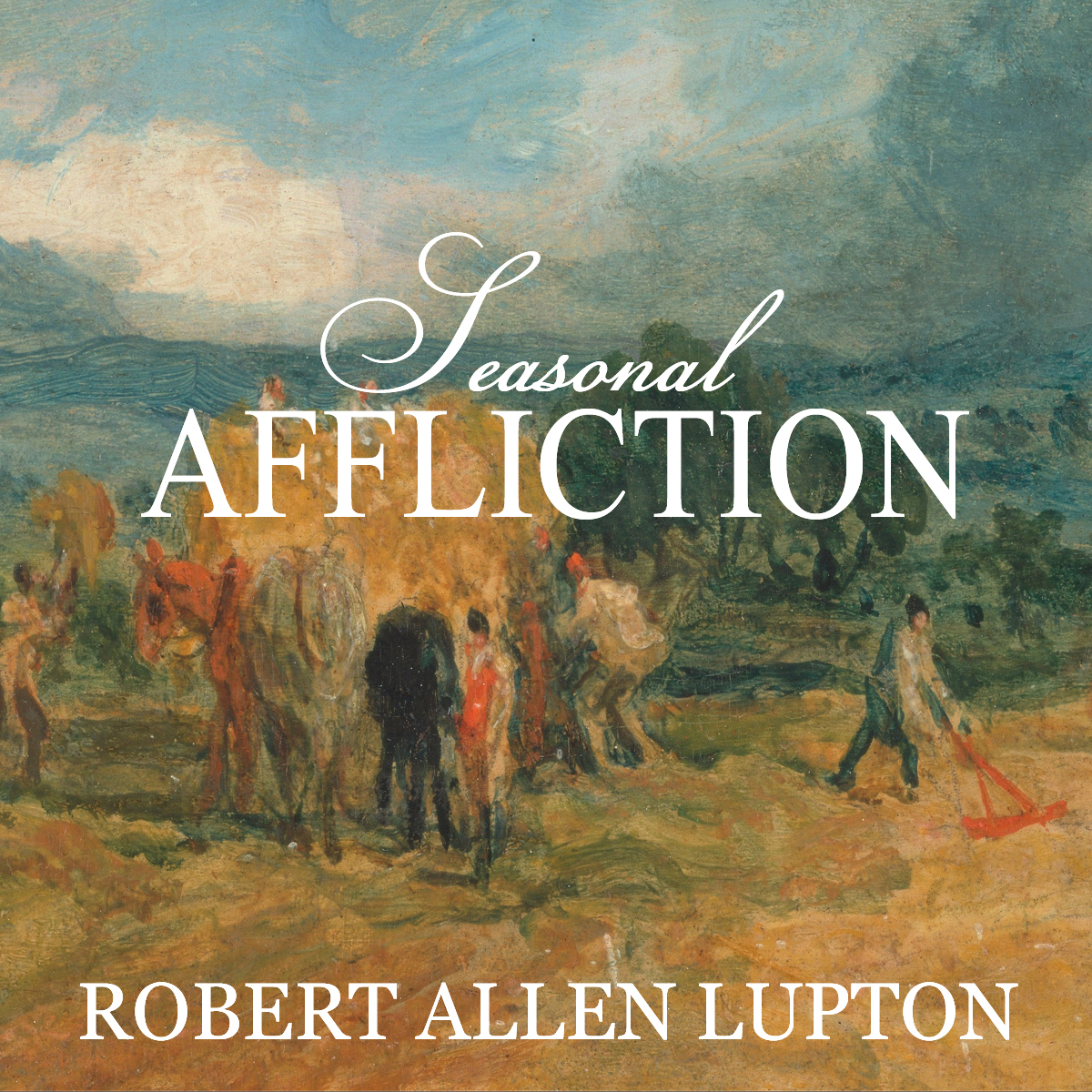
Seasonal Affliction, By Robert Allen Lupton


A farmer had five sons and when he died his farm was divided into equal shares, one for each son. The sons worked hard, married, and had good harvests for several years.

One year, the sons loaded their extra produce on their wagons, drove to town, and sold their crops at market. On their way home, they encountered an old woman covered in mud. She sat crying near a stream.


Her wagon was turned over and most of her belongings were scattered along both sides of the stream. Her two horses were mired in the mud.


The brothers, being of good heart, stopped and helped the old woman. They dug her horses from the muck and mire. They uprighted her wagon and pulled it from the steam. The oldest and youngest brother repaired two broken wheels and the other three gathered the woman’s belongings from the stream. The middle brother brought the woman water to drink and water to clean herself.


They hitched the woman’s horses and then helped her into her wagon.


The oldest brother said, “What a beautiful day. We fared well at market and were rewarded by helping you in your difficulties. Safe travels.”


The old woman replied, “Don’t be so quick to leave. I thank you. I am not just an old woman. I am a weather witch and I would reward each of you with a boon, a wish if you will. What would you have from me?”


The brothers laughed among themselves for they were ones who believed in hard work rather than witchcraft. The youngest brother said, “Let us make wishes. It will make her happy and will do us no harm.”


The youngest spoke first to the witch. “I hate winter. I hate cold and I hate chopping wood. I would have no winters on my land.”


The second son said, “Spring makes my eyes water and my nose run. I hate rain. I would have no spring on my land.”


“Summers make me sweat. I hate heat. No summers for me.”


The fourth brother complained about fall and hating the hard work that comes with the harvest.


“As you will,” said the witch.


The oldest brother thought carefully and asked if he might wait before requesting his favor.


The witch agreed and said that he could have a year and a day to make his wish, but no more. They agreed to meet at the same spot in a year and a day. The brothers and the witch went their separate ways.


A year later, the four younger brothers came to the oldest brother’s house.


The youngest complained. “Without winter, the soil didn’t have time to rest and my crops were weak and died during the hot summer. We’re starving.”


The second brother said, “With no spring rains, my crops wilted and died in the over-long summer.”


“Without a summer, my crops were not ripened when the first killing frost came. I lost everything.”


The fourth brother hung his head. “With no fall to make the harvest, my crops died when winter came.”


The oldest brother had made a great harvest and had food in abundance. He welcomed his brothers and their families and promised to feed them.


The youngest brother promised to work hard and even chop wood for the coming winter.


The oldest brother said, “It is good that you are here for tomorrow is a year and a day since you made your wishes. Come with me. We will meet the weather witch and I will make my wish.”


The next morning the five brothers met the old woman at the stream. She greeted them with great cheer. “Hast your wishes worked as you hoped.”


“No, they haven’t,” said the oldest brother. “They didn’t choose well. For my boon, I ask that you restore the seasons and the weather to my brothers’ lands. Make things as they were before.”


The weather witch looked at the brothers. “Would you have me cancel your wishes?”


“Gratefully,” said the youngest.


The witch agreed and rode away. The brothers never saw her again.


The five brothers all grew good crops the next year and the year after that and for many more years. They worked hard. They rested in the winters, planted in the springs, weeded and watered in the summers, and made harvests in the fall. They never complained about the cold or the heat. They laughed in the rain, sweated in the hot sun, and marveled at the lightning and thunder.


They taught their children to take the weather as it comes, for nature knows what it needs. There are reasons for the seasons.

Robert Allen Lupton is retired and lives in New Mexico where he is a commercial hot air balloon pilot. Robert runs and writes every day, but not necessarily in that order. Over 180 of his short stories have been published in various anthologies. His novel, Foxborn, was published in April 2017 and the sequel, Dragonborn, in June 2018. His third novel, “Dejanna of the Double Star’ was published in the fall of 2019 as was his anthology, “Feral, It Takes a Forest”. He has four short story collections, “Running Into Trouble,” “Through A Wine Glass Darkly,” “Strong Spirits,” and the newest story collection, “Hello Darkness,” was released on February 14, 2022. All eight books are available from Amazon.


Cover: Amanda Bergloff

Twitter @AmandaBergloff

Instagram: amandabergloff 

SITE DESIGNED BY PRETTYWILDTHINGS