navigation

Check out my EC Guest Poster posts!
Showing posts with label EC Guest Poster. Show all posts

October 29, 2012

Haunted Folklore (Part Five): Animals, Objects and Other Oddities, By Kristina Wojtaszek

Editor's note: Here is the last in Kristina Wojtaszek's "Haunted Folklore" series, which EC has been proud to present this month. With her story, "Cinder," Kristina was one of the authors who contributed to to Specter Spectatcular, published by World Weaver Press. Links to both Kristina's blog and the book can be found below.

Many thanks to Kristina or her fun and informational series.


Though widely varied in appearance and cultural affiliation, most of the ghosts of folklore take on a rather human shape; but such is not always the case. In African and Native American folklore, legends of animals and ghosts abound, but the two are not often one and the same. Still, there are cases of animal ghosts in folklore. Frightening fairy dogs can be found roaming the streets of Ireland, while in Europe headless horses ride the skies in the Wild Hunt, or are ridden by headless horsemen--and what about that spooky head of the horse in "The Goose Girl"? There are talking fish bones, phantom birds and even incorporeal cows (was that boo or moo?). In the Scottish version of "Cinderella," "Rushen Coatie," the girl's mother returns as a cow to provide nourishment for her child, following which the cow's bones act in the same manner as the haunted fish bones in the older, Chinese tale. Departed humans whose spirits return in animal form are not all that uncommon. Selkies, creatures of lore who can change shape from seal to human, may be the powerful spirits of those who have drowned. In "The White Trout," a betrothed woman is murdered, and her body dumped into the river. She later returns in the form of a white fish to haunt the waters while waiting for her lover. In the gruesome tale "The Juniper Tree" a murdered stepson takes the form of a sparrow after his sister lovingly lays his bones beneath the tree. He then goes to various townsfolk to sing of his death at the hands of his stepmother.

The motif of bones stirring to life to sing of injustice is also shown in the many variations of "The Singing Bone." During a contest to find a special object appointed by the king, or father, of two children, one is successful and stands to inherit the throne, or family property, until the unsuccessful sibling decides to murder them. One of the victim's bones is later found and turned into a flute that sings their song of betrayal and death, for which the murderer is punished if still alive.
 

Another tale of convicted guilt is that of "The Red Shoes" by Hans Christian Andersen. A young girl is so prideful of her new, red shoes that she can't help showing them off, even at inappropriate times. For this she is cursed to dance ceaselessly in her shoes until her feet are cut off, still in the shoes she couldn't remove. They continue to haunt her however, her dismembered feet dancing before her every time she tries to enter a church. Other strange objects that haunt include spectral ships (the ghosts of those vessels destroyed at sea), phantom paintings, mirrors, spooky bells or other self-playing instruments, and in modern lore, items such as radios and televisions. Another strange sight are the spectral lights of swamps and deep forests, often said to recede when followed, leading one ever farther from home. Both the Jack-o'-lantern and Will-o'-the-wisp are references to legendary lost souls (named Jack or Will, respectively) cursed to wander the night with only the aid of a torch, a candle, or a piece of burning coal (hence the light).

Bremen Town Musicians, by L. Leslie Brooke
Aside from haunted animals and objects, another oddity of folklore is the tale of humor that often centers around a mistaken spook. In one such tale, "The Town Musicians of Bremen," an odd group of animals scare the daylights out of a gang of robbers who only think they are ghosts (due to the awful "music" they make in the middle of the night). Some of the entertaining Native American folktales also speak of false hauntings, like "How Raccoon Got His Mask" (how did he? By disguising himself as a ghost, or course!).

Whether you enjoy tails of terror, humorous hauntings, unnatural romance, or favorite fables, you're sure to find what you're looking for and more within the vaults of folklore. And for 13 of the newest twists on tales of spooks, check out Specter Spectacular: 13 Ghostly Tales from World Weaver Press. Go ahead, take a good look around; the dead are everywhere. Just don't forget to take a lantern and scatter a few stones to mark your way home.

Kristina Wojtaszek grew up as a woodland sprite and mermaid, playing around the shores of Lake Michigan. At any given time she could be found with live snakes tangled in her hair and worn out shoes filled with sand. She earned a bachelor’s degree in Wildlife Management as an excuse to spend her days lost in the woods with a book in hand. She currently resides in the high desert country of Wyoming with her husband and two small children. She is fascinated by fairy tales and fantasy and her favorite haunts are libraries and cemeteries. Follow her @KristinaWojtasz  or on her blog, Twice Upon a Time.

October 11, 2012

Haunted Folklore (Part Two): Spectral Celebrations, by Kristina Wojtaszek

Editor's note: Here's part two of Kristina Wojtaszek's darkly (well) detailed series on macabre traditions all over the world. Honoring the dead is in the spotlight this time, and Kristina takes readers all over the nether world in this post. 

Kristina's short story, "Cinder," is one of 13 in an anthology recently published by World Weaver Press called Specter Spectacular: Thirteen Ghostly Tales. For a peek at Kristina's tale, which I have read and thoroughly enjoyed, click here.


Several rows of "empty" chairs are placed before live performances in China during the Hungry Ghost Festival. These are reserved for the dead, who return through the open gates of the underworld--with an appetite. Some of the spirits have necks stretched thin and pine for food, as well as every other part of a life left behind. Once burned in offering, Joss paper (made from bamboo or rice) can be used as money or objects in the afterlife. Joss paper can be formed into everything from toothbrushes to sports cars. At the end of this month-long festival, lotus-shaped paper lanterns are set to float away, leading the ghosts back to their former realms.

Every culture, every country, has its stories and traditions gathered around ghosts. Even in the skeptical U.S. we take part in holidays that have pagan roots in paranormal legends. Halloween is in fact a remnant of the Gaelic harvest festival Samhain, celebrated on the last day of autumn, during which the world of spirits was believed to be closer to the physical earth than at any other time of year. Mexico's Day of the Dead is probably the most well known spectral celebration that persists today. The day before All Souls' Day (celebrated on November 2 by Roman Catholics) Mexican families gather together to welcome home their deceased relatives, who settle in the mountain pines in the guise of monarchs. Baron Samedi, the god of death in Haitian culture, receives offerings of spiced alcohol after loud music is played to awaken him during the holiday of Ghede, which also occurs in conjunction with All Souls' Day.

Saint Giles--His Bells, by Charles Altamont Doyle

Much like the Day of the Dead, the Obon or Bon Festival in Japan is a Buddhist holiday during which families assemble to clean and care for grave sites, and the spirits of the departed are expected at the family alter. During Pitru Paksha in India, prayers and food offerings are made to the last three generations of lost loved ones in order to help them cross over to heaven. Rather than butterflies, their departed are said to appear as crows to except their offerings. In Nepal, ghosts are lead to the afterlife by cows in the Gai Jatra. After this somber procession comes a time for merriment with costumes and satire. Rather than dressing up themselves, during Bolivia's Festival of Skulls it is the skulls that are decorated and given gifts, such as cigars tucked between their teeth. In return, the dead reward their relatives with blessings. Wrestling matches are often a part of the celebrations in Korea's Chuseok festival. Celebrated during the fall, offerings of the harvest are made to the dead in thanksgiving for a bountiful year. In Sicily, the children who pray for the souls of the departed leave their shoes out, hoping for sweets and toys left by the ‘muorti’ (the dead), helping them to hold onto memories of lost loved ones.

Even more universal than fear, it seems that celebration, dance and offerings are in order to honor the dead. As the medieval Dance of Death showed to celebrants each year, death is undeterred by belief, class or culture; death unites all.

Kristina Wojtaszek grew up as a woodland sprite and mermaid, playing around the shores of Lake Michigan. At any given time she could be found with live snakes tangled in her hair and worn out shoes filled with sand. She earned a bachelor’s degree in Wildlife Management as an excuse to spend her days lost in the woods with a book in hand. She currently resides in the high desert country of Wyoming with her husband and two small children. She is fascinated by fairy tales and fantasy and her favorite haunts are libraries and cemeteries. Follow her @KristinaWojtasz  or on her blog, Twice Upon a Time.


July 6, 2012

The White Marriage, By William Saunders

Editor's note: What a marvel William Saunders has created with this story. Fragments of magic, slivers of drama, shards of history, are all mingled together in a reverie called, "The White Marriage."  EC is delighted to present the story as a guest post, as it seemed the best category in which to place it. Enjoy!

Once upon time there was a beautiful princess, and she married a handsome prince, who took her far away across the sea to rule with him over the city of Prague.

And Prague in November resembled an enormous wedding cake, as the Princess, who was now a Queen looked out of her castle window.  After a night of snow, the roofs and the spires of the city shone and sparkled as if they were gorgeous curlicues teased out of sugar by a clever pastry chef. Only if she leaned very far out of the window could she find any sign of the dark earth at all.

Down below among the cottages pressed against the wall of the castle the snow had not settled due to the steady tread of the alchemists going back and forth to fetch coal. Day and night they tended their fires in pursuit of the secret of immortality.

Jessie Dunlop

As things fell out this November, the Queen was alone in the Castle because the Prince, who was now a King, was away making war on his enemies at the White Mountain.  For company she had her three companions from home, Mary, Mary and Mary, and the four of them gossiped and giggled together in their native tongue as they wandered the enormous rooms, but there was no real life to be had with all the men away. The Queen also had her English players with her and that afternoon they were to perform a masque for the ladies. 

Not every man had gone to the war. Down below in the city there was a young soldier who had decided to seek his fortune by other means. He had rented a small room, with a stove to sit by as he thought and thought about how to decide what is real and what is only a dream.

The English players are the mechanics of dreams. Together they raise the scaffold in the Castle throne room with easy practice - the platform on which they will become kings and even queens, although they are all men and boys.  Mary Carmichael will not leave them alone. She hangs around the doorway as the crashes of the scaffold work echo up in the rafters of the Throne room, with no thought of her dignity.

She is fascinated by Rufus, the lead boy of the company who takes the main feminine roles. She loves to finger his tinsel dress and stroke his down chin and ask him "How can you play a woman when you've never known one?"

Rufus blushes but answers, "I play maids."

"Oh! Oh!" shrieks Mary Carmichael "That's put me in my place, for I could only play a maid from memory." Her laughter skirls through the great chamber high above the laughter of the men. Rufus blushes deeper, and Mary pinches his cheek and says "He blushes like a maid." But the Queen has heard the laughter and has sent Mary Seaton to take Mary Carmichael away from the players.

So the Queen and all three of her ladies walk together in the long gallery before dinner, their breath hanging before them in thin white clouds. They talk of Grace, the snow, Anabaptists and Mary Seaton's small dog, Duncan, who runs ahead of them and snuffles at the fringes of the tapestries. None of them mentions the war.
Dinner without the men is a jolly affair. Among only themselves and waited on by women, the ladies can forget their manners and be free with their appetites. Mary Carmichael is always greedy, and Mary Heaton enjoys her food when she gets the chance, although she is as thin as a needle. There is no fish, with so many men away, but even in November there are peaches and plums grown magically under the low winter sun in a room with glass walls on the roof of the castle.

When at last dinner is cleared away the light has begun to fade. Much of the throne room is already lost in shadow as the Queen leads the Marys in to see the Masque. The stage is lit with sconces, and up in the gallery the musicians have lit their candles. One could fancy that the pin pricks of candlelight are the stars in the sky. And such fancies are what make the Queen uneasy about Theatre. Surely to make a mockery of Nature is to mock its Creator? And the better the mockery the greater the spiritual danger, for a perfect imitation of form will draw Spirit into it, like the brazen head built by Cornelius Agrippa which spoke and prophesied. And in this poor light the Imagination will spring to the aid of the Intellect to make the stage, and only the stage real, and what are the dangers of the perfect illusion?

Rufus is the perfect illusion now, as he steps onto the empty platform of the stage. Who could doubt that he is what he claims to be, the Lady Moon in the Garden of the Night? He moves with delicacy and modesty. His feet glide beneath him, his arms float before him has he uses his hands to emphasize his unhappy situation, and his horse hair tresses fly around him with each toss of his head.

The Lady Moon has nightingales and owls for company and it is the sweetest scented flowers which exhale their perfumes during the hours of darkness. Yet all is not well with her. She loves the Lord Sun, loves him and fears him, for she is afraid that in his great light she will disappear. She would take that risk but her cruel father Saturn keeps her away from her lover.

The Queen hears Mary Heaton draw her handkerchief from her sleeve ready to weep for Lady Moon. The Queen is moved too. She knows what is to be the daughter and lover of powerful men. She is gripped rather more than she would like.

Here comes Mercury, a lithe and nimble lad, resplendent in yellow robes. His dances and songs are so gay that even Lady Moon forgets her troubles and laughs.  Mercury brings hope as well as laughter, for he knows a way to bring Lady Moon together with her love, but it will require her to change completely. Lady Moon asks herself if she dare trust Mercury, the Guardian of the Dead, the Master of Shadows and decides she has no choice. They depart in different directions.

Here comes Lord Sun in golden armor. All the ladies gasp. His heralds are the roosters, his knights are the eagles. He is all seeing and master of all that he can see. Poor Lady Moon, for surely such a magnificent being must be complete in himself? He who has everything must want nothing. Lady Moon's cause must be hopeless.

Yet, strangely, Lord Sun is susceptible to flattery. Mercury skips on and sings his praises and his Lordship is very pleased. Sly Mercury then sings a song of longing and love from afar. Lord Sun is moved and asks where Mercury learned it. Mercury says that he heard it from a lady in a secluded garden, a garden where the Lord Sun can never go.

Lord Sun is devastated, he wants more than anything to enter the garden and court the lady. Mercury promises that he can arrange just that but it will involve great sacrifice on Lord Sun's part. Without hesitation the Lord Sun says he will agree to anything that Mercury asks of him.

Lord Sun departs and Mercury reveals to his select audience that his game is deeper than either Lord Sun and Lady Moon can guess. Their marriage will be the accomplishment of the Great Work. He summons his two servants Castor and Pollux to send word to Lord Sun and Lady Moon to meet him in the Garden of the Hesperides, the garden in the West, where Day and Night meet.

Castor and Pollux are not the most competent of servants but after a few misadventures together which set the Queen and her ladies laughing, they go their separate ways to perform their errands.

Mercury appears again and announces he is in the Garden of the Hesperides the orchard whose golden fruit bring wisdom and immortality to any who dare to eat of them. Lord Sun and Lady Moon appear form opposite sides of the stage. After they have sung in celebration, Mercury instructs them to strip to their shifts. Then the atmosphere darkens. Lady Moon announces that her cruel Father Saturn is about to arrive and stop the wedding.

In fact it is another person altogether who stops the ceremony. A young knight runs into the throne room and falls on his knees before the Queen. The mud and the blood on his clothes speak of his valor and yet he weeps like a child. Through his tears he tells the Queen that the King has been defeated at the White Mountain and she and her ladies must flee Prague that very night.

Lights are called for everywhere and all the servants are stirred up to pack whatever can be carried off. Mary Heaton begins to weep and the Queen tells her if she has tears to shed she should not waste them on herself but cry for the women of Prague who have nowhere to flee to and must await the mercy of the enemy army.

Down below in the city the young soldier wakes up beside his stove, and in the moments between sleep and waking he realizes he is dreaming his life and in those same moments he realizes that if he is dreaming himself, there must be a self to do the dreaming. And in the years that were to follow, the young man wrote his thoughts about this in a book, and many wise men have come to believe that the young soldier was right.

Jessie Dunlop

And beside the Castle the Alchemists went back forth to fetch coal as they always did. Day and night they tend their fires in search of the secret of immortality: living, in effect, as if they had already found it. 


Bio: William Saunders is a London based poet, journalist and author. His collection of short stories is called Leah And Her Twelve Brothers.

Bio: Jessie Dunlop is an archaeologist who lives in Vancouver. These are her first published illustrations.

Links:
Leah And Her Twelve Brothers

EC readers are invited to download "The White Marriage" as a free .pdf here:
http://www.stormbooks.biz/images/stories/writers/William_Saunders/william_saunders_sample_prague.pdf

or via this page where it is listed as Prague.
http://www.stormbooks.biz/index.php/williamsaunders

June 7, 2012

Dancing With the Devil (and Other Strategies for Fighting Evil), By Lissa Sloan

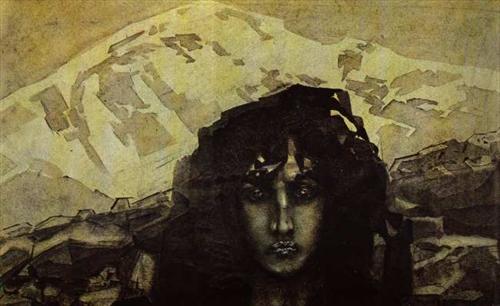
Editor's note: The Devil gets plenty of due in fairy tales, as Lissa Sloan adeptly points out in this guest post. The image here is not exactly a perfect fit, but is too darkly lovely to resist.

No one wants to run into the Devil, right? What with him leading people into temptation, and making bargains for their immortal souls, it’s just too risky. But it works out fine for Colonel Philip Lightfoot, an arrogant Colonial Virginian who is challenged to a dancing contest by Satan himself. His tale is recounted by Mary Quattlebaum in Sparks Fly High: The Legend of Dancing Point. Fortunately for Colonel Lightfoot, he realizes the error of his ways in time to mend them, and beats the Devil at his own game.


But what if you are not light-footed, but two-left-footed and you encounter the Prince of Darkness? As usual, fairy tales provide some useful suggestions. Number one: be clean (spiritually and physically). In The Handless Maiden, the maiden’s father promises his daughter to the Devil (in his defense, he thinks he’s giving up his old apple tree, not his daughter). When the Devil comes to claim the girl, he cannot, because she is not only morally clean, but has just bathed. She is forbidden to wash anymore, but when the Devil returns, her hands are still clean, because she has wept on them. It is then that her father is ordered to cut off her hands. (In his defense, the Devil does make him do it.) But even then, her tears keep her clean, and the Devil cannot touch her. He continues to plague her though, and it is because of her purity of soul that she always receives the help she needs.

Head of the Demon, by Mikhail Vrubel (1891)
Of course, we can’t all be pure and clean. A second possibility: be smart. In Bearskin, the Devil makes a deal with a soldier to provide him all the money he could want or need in return for a few things. The soldier cannot wash (about cleanliness, see above), or cut his hair. He must wear the skin of a bear, and he cannot pray. If Bearskin dies during the seven years of their bargain, his soul belongs to the Devil. If he survives, he is free. Bearskin knows he cannot pray that God spare his life, but he finds a loophole in the deal. He gives money to the poor, asking only that they pray on his behalf. Fortunately for Bearskin, it works.

But sometimes being clean and smart just isn’t enough. The third option: it’s not what you know, but who you know. In The Devil and His Grandmother, our hero, another soldier, confesses his situation to the Devil’s Grandmother. The obliging old lady takes pity on him and hides him while she ferrets out the answer to the riddle he must answer. In The Devil with the Three Golden Hairs, the Grandmother even risks her grandson’s ire by yanking out his golden hairs. So if you meet Old Scratch, take heart—there is hope. Be pure, be smart, or use your connections. Or maybe just brush up on your dancing.

Lissa has been a guest blogger on Enchanted Conversation, and contributed a poem to the Little Red Riding Hood issue. Despite many years of lessons, she would definitely not bet her soul on her dancing ability.

May 30, 2012

Once Upon a Time: Emma's Baby Blanket, By Samantha Kymmell-Harvey -- A Guest Post

Editor's Note: Today's guest post can be seen as a companion piece to a post about ABC's hit TV show Once Upon A Time, by Samantha Kymmell-Harvey and published in EC a few months ago. Together, they give us a great picture of what is appealing about the show.

With all that’s going on in ABC’s Once Upon a Time it’s so easy to overlook the tiny details that just might make difference in future episodes. Like Emma’s baby blanket. We see Granny stitching it in the pilot. Next, we see it draped across the back of a chair in Emma’s Boston apartment. Finally, she brings it with her when she moves in with Mary Margaret.  Why would tough Sheriff Swan keep her baby blanket? “Because it’s all I have of my parents,” she tells Nicolas and Ava (Hansel and Gretel in Fairytale Land), with whom she feels a strong connection because they too have lost their mother and father.

Gustave Dore (altered)
What if Emma’s baby blanket is more than just a memento of her parents and proof of her  true name? What if it, perhaps, it possesses a special quality? At the moment, this is pure speculation -- but it wouldn’t be the first time an Otherworldly mother, forced apart from her family, leaves behind an extraordinary blanket for her child.

In the highlands of Scotland, Dunvegan Castle proudly displays the Fairy Flag of the Clan McLeod. Legend has it that a handsome chief of the MacLeod clan fell in love with the beautiful daughter of the Fairy King. Despite her father’s warning that the human would grow old and die, the fairy princess insists on marrying him. So the King grants her permission to remain in the human world as Chief MacLeod’s wife for one year and one day. They are happily wed and soon a son is born to the couple.

But when a year and a day had passed, the Fairy Princess tearfully leaves her husband, warning him that the baby must not be allowed to cry, for she would hear it and it would pain her.

On Chief MacLeod’s birthday, there is a great celebration with a feast and music for dancing. When the baby finally falls asleep, his young caretaker sneaks out to enjoy the music. She does not hear the child begin to cry. But the Fairy Princess does, and she returns to her son’s crib, wraps him up in her fairy shawl, and lulls him to sleep with her magical words. In the morning, they find the baby sleeping peacefully, wrapped in a silk cloth of yellow and red elf-dots.

This shawl is the Fairy Flag. The princess tells her son that if the MacLeods find themselves in mortal danger, they need only to wave the flag and the Fairy Folk would come to their aid.

The Fairy Princess bequeaths this protective blanket to her child, just as Snow White wraps baby Emma in a blanket before sending her to the human world to protect her from the curse. Maybe her blanket is ordinary, but perhaps it possesses the love and protection of an Otherworldly mother separated from her child.

Samantha Kymmell-Harvey’s work can be found in Fantastique Unfettered, Underneath the Juniper Tree, and The Urbanite.

Check out her blog at samanthakymmell-harvey.blogspot.com
SITE DESIGNED BY PRETTYWILDTHINGS