navigation

Check out my Fairy Tale Food by A.M. Offenwanger posts!
Showing posts with label Fairy Tale Food by A.M. Offenwanger. Show all posts

December 13, 2018

FAIRY TALE FOOD: The Gingerbread House by A.M. Offenwanger

Editor's Note: It's December, and it's the perfect time to make a gingerbread house! EC is pleased to showcase author A.M. Offenwanger's thoughts on fairy tales and food this month with her article that includes a recipe for a gingerbread house (originally published on her fabulous blog.)

“What came first,” my husband asked when I made this gingerbread house last year, “the pastry or the fairy tale?”
Good question. So I looked it up. According to the internet (scholarly fount of all wisdom), there isn’t any clear indication of when the first gingerbread house made its appearance on the scene of Christmas goodies, but it does seem that it was after the Grimms’ “Hansel and Gretel” became popular. Gingerbread men or other gingerbread figures for gift-giving had been around since the Middle Ages, more or less, but shaping it into a house and glueing candy on it seems to have been inspired by this lovely story of child abandonment, attempted infanticide, and cannibalism.
I have to say that that fairy tale was never one of my favorites – I prefer stories without bad guys, and this one has not only one very bad witch, but a nasty stepmother to boot. I did like Gretel’s bad-ass vanquishing of the witch, and the ending where Hansel and Gretel get home to their father and live happily ever after.
What I didn’t notice as a kid, though, was that Daddy isn’t that much of a good guy either. In fact, he’s an utter wet noodle; all his moaning and guilty conscience doesn’t make up for the fact that he lets his wife talk him into abandoning his kids in the forest. It even occurs to him that it would be better for him to share his last piece of bread with them and then starve together with them, but does he act on it? Not Mr Wet Dishrag, no. Standing up to the wife would require a backbone, and that he hasn’t got. Macbeth, indeed, has nothing on Hansel Sr.
Another thing I never knew is that originally, the Grimms told the story with the nasty wife being not the children’s stepmother, but their real, biological mother (the stepmother entered the narrative around 1843, according to Hans-Jörg Uther*). Now doesn’t that put a nice spin on the story? Your mom is feeling a bit peckish, so in order as not to starve, she sends you out into the woods to die. Oh yeah, and Daddy ties a stick to a tree that makes a tapping noise so you think your parents are still around, chopping wood, while they sneak away and leave you to your doom. You’d think the witch would come as somewhat of a welcome relief after that kind of loving home life… So that’s your tragic backstory, beforeyou even run into the cannibalistic witch with the overkill kiddie trap.
Oh yes, that trap? Grimms says specifically that the witch only built the bread house to lure children, not because it was her preferred construction material for superior country cottages. I’d call that overkill, wouldn’t you? Because, as I can tell you from experience, building a gingerbread house is a lot of work.
However, it’s also a lot of fun. Here is a relatively simple version (not cheap, because of the honey, but that does give it a great taste and texture). No windows made of spun-sugar “glass”, but hey, if you want, you can add those, too.
Incidentally, you might note there is no ginger in this “gingerbread” – there never is in German Lebkuchen. Just plenty of other spices, which were historically so expensive they were reserved for Christmas baking (and sometimes all lumped together under the term “pepper”, hence the alternative term “Pfefferkuchen” – pepper cake – for gingerbread. You might know it from “Pfeffernüsse“, the cookie).

Gingerbread House**

(this makes one large house plus several tiny ones and a bunch of gingerbread people or bears. For just a house, half the recipe will do. Imperial measurements are approximate.)
HOUSE
-1 kg (2 lbs) Honey
-250 ml (1 c) Water
bring to a boil; cool.
Mix/knead into:
-650 g (5 c) Rye Flour
-600 g (5 c) White Flour
-100 g (3 oz) each finely chopped Candied Lemon & Orange peel
-40 g (3 Tbsp) Lebkuchen-Spice (see below)***
-30 g (3 Tbsp) Baking Soda
Let rest for a few hours, up to a day or two.
For cookies or small gingerbread houses, roll out 1 cm (1/4″) thick, bake about 7-9 minutes at 400°F (200°C).
Dimensions for the large witch’s house:
Base plate, ca. 20×30 cm (8×12″), prick with fork, bake 12-18 minutes.
Roof (x2): 13×20 cm (5×8″).
House walls: (x2) 8×16 cm (3×6″); (x2) 16 cm (6″) wide with 16 cm (6″) high at the point of the gable.
Cut windows out of the side walls and a door out of one of the gable walls (can also be done immediately after baking). Bake ca. 12 min.
Make fence posts, window shutters, chimney pieces, small trees etc. out of the remaining bits of dough – maybe even a Hansel and Gretel and a witch?
Cool everything.
ICING
-500 g (1 lb) Icing Sugar
-2 Tbsp Lemon Juice
-3 Egg Whites
Mix together to thick consistency (kind of like peanut butter). If it’s too runny, add more icing sugar; if too stiff, more lemon juice or water, a teaspoonful at a time. If you want to keep it vegan, skip the egg whites and just use lemon juice.
For the house construction, you might want to trim the edges with a knife so they are straight and hold together better. Support the roof plates (prop a cup under the bottom edge) until the icing has dried a bit and they no longer slide off. When things are holding together, go to town with covering everything in icing “snow” and candies. “Icicles” at the corners of the roof can be achieved by dribbling runny icing down the edge.
***Lebkuchen-Spice (Neunerlei – Nine Spice)
Lebkuchen spice can be bought ready-mixed, but if you can’t get it, here’s my own blend that I made up from the ingredients list on the package. All the spices are ground.
Zest of 1 orange & 1 lemon
1 1/2 tsp cinnamon
1/2 tsp coriander
1/4 tsp star anise
1/4 tsp nutmeg
1/4 tsp mace
1/4 tsp fennel
1/2 tsp cloves
1/4 tsp cardamom
To build into full-size cottage, multiply ingredients by approximately 500. Proceed as above, but build roof out of smaller tiles and use scaffolding for construction. In case of intrusion by marauding small children, keep phone number of child welfare services on hand to report the parents for abandonment.
References:
*Hans-Jörg Uther, Handbuch zu den Kinder- und Hausmärchen der Brüder Grimm. Berlin: de Gruyter, 2013. p.13.
**recipe adapted from: Christian Teubner & Annette Wolter, Backvergnügen wie noch nie. München: Gräfe und Unzer, 1984.
A.M. Offenwanger is a writer, reader, blogger, and editor.
Follow her blog Amo Vitam
and on Twitter @amoffenwanger
and Facebook here

All Photos by A.M. Offenwanger

July 5, 2018

FAIRY TALE FOOD & RECIPE OF THE MONTH: Sleeping Beauty and Sauce Robert by A.M. Offenwanger

What does Sleeping Beauty have 
in common with Sauce Robert?
A.M. Offenwanger shares a fairy tale and combines it with a recipe in this month's 
Fairy Tale Food feature:
”Sauce Robert, Julia Child says in Mastering the Art of French Cooking, is a brown mustard sauce with lots of onions and white wine, and is served with roast or braised pork, boiled beef, broiled chicken, hot meat leftovers or hamburgers. Obviously, Julia Child hadn’t read “Sleeping Beauty”, or she would have added “roast or broiled baby” to that list of acceptable meats. Well, at least the ogress thinks that Sauce Robert would go well with cooked toddler; her chef disagrees.

What? You didn’t know about the ogress and the broiled baby? What version of “Sleeping Beauty” were you looking at? Oh, probably the same one I’m familiar with—lovely, tender Grimms’. That’s right, when it comes to “Sleeping Beauty”, the Grimms were the sweet, child-friendly storytellers; Charles Perrault’s version is a whole lot more grim. If you think that “Sleeping Beauty” is the story of a princess who pokes her hand with a spindle, falls asleep for a hundred years in a rosebush-covered castle, is kissed awake by the prince, and lives happily-ever-after-the-end, you only know half the tale—the half the Germans decided to write down as “Dornröschen”.
The French, on the other hand, went a little further than that—PG13, at least. Oh yes. Sex, teen pregnancy, family violence, attempted cannibalism, poisonous creepy-crawlies, this one has it all.

Up to the point where the prince finds the beautiful princess on her beautiful bed, the Perrault version is pretty much the same as the Grimms’, but then it goes off the rails.

The prince, after a lovely wedding night with Beauty (who, from what I can gather, is around fifteen or sixteen at this point), goes home and lies to his parents about where he’s been—in the cottage of a charcoal burner, he says (uh-huh, yeah, sure you were!). His dad, being “a good man”, believes him; the queen, his mother, for whose benefit the lie was concocted in the first place, does not. The mother, you see, is an ogress who likes to snack on children. The prince keeps inventing excuses for “having to go hunting”, so he can go back to Beauty’s castle. What they’re doing there you can deduce from the subsequent births of their daughter, Morning, and a year later their son, Day.

Once the prince’s good-but-gullible father dies, the young man announces his marriage and brings his wife and children home to Mama Ogress. Bad choice. The newly-minted king goes off to war with his next-door neighbour, and—what do you know?—almost as soon as he’s gone the dowager queen gets a little peckish. She packs her daughter-in-law, the young queen, off to a country house in the woods, and orders cook to roast up her granddaughter, little Morning, with—you guessed it—Sauce Robert. No, really, Perrault specifically says so. The cook tricks the ogress by giving her roast lamb instead; the following week, when she thinks she’s eating little Day, it’s a kid (i.e. baby goat, not baby human), and finally venison in place of Queen à la Sauce Robert.

The ogress quite enjoys the meals, until she finds out the queen and her children are still alive, whereupon she loses her ogreish temper and commands them all, cook included, to be executed by immersion in a tub full of poisonous toads, vipers and snakes. Fortunately, at the last minute, the young king comes back from war (I guess he got off work early), and the ogress-queen-mother is so peeved she commits suicide by jumping into the viper tub. The king, being of a somewhat sentimental disposition, “could not but be very sorry, for she was his mother”, but consoles himself with his wife and children, and they do, presumably, live happily ever after.

And you thought the Grimms were grim…
But at least Perrault didn’t go as far as the even older Italian version, Giambattista Basile’s “Sole, Luna e Talia” (“Sun, Moon and Talia”). It follows roughly the same outline as Perrault’s story, except that in this version, the ogress isn’t the young king’s mother, but his wife. That’s right, the guy is already married when he finds the sleeping Talia—who, incidentally, is doomed to sleep as long as a sliver of poisoned flax is still stuck in her finger. So this king doesn’t even bother waking the girl up; he feels “his blood course hotly through his veins”, “gather[s] the first fruits of love” (which are a little more than a kiss), and leaves again.

Talia, still soundly asleep, gives birth to twins (Sun and Moon). One of them, in search of a nipple, sucks the splinter of flax out of her finger, and she wakes up. After that, the story pretty much goes back to the Perrault plot, with fewer vipers and a better reason for the first queen to resent Talia, but at the end the wicked queen is dead, the king finally makes an honest man out of himself and marries Talia, and they live happily ever after. So here we have adultery and rape added to the mix of motifs, but hey, the story’s got a moral: “Those whom fortune favours / Find good luck even in their sleep.”

Do you still wonder why we stick with telling the Grimms’ version of the story? Pass the Sauce Robert, please.

I’ve never tasted, let alone cooked, Sauce Robert myself—it seems a fairly involved process that calls for veal stock, which is very hard to come by around here. I found a likely recipe here, if you want to give it a try.

An easier sauce that I make a lot, though, is
WHITE SAUCE or CREAM SAUCE.
It’s very versatile.
Ingredients:

  • 2 Tbsp butter
  • 2 Tbsp flour
  • 1 c. milk or other liquid (see below)
  • Salt and pepper to taste

Steps:

  • In a small saucepan, melt butter over medium-high heat.
  • With a wire whisk, stir in the flour. Cook for a little while with the butter. You can even let it roast to a nice, nutty brown for more of a Sauce Robert effect.
  • Pour in a 1/4 cup of the liquid.
  • Whisk smooth, bring back to a bubbling. Keep adding 1/4 c. at a time, whisking smooth and letting it come back to a boil after each time.
  • Season with salt and pepper
  • If it's too thick for your liking, add more liquid. If you like it thicker to work as a gravy, whisk some more flour into a bit of cold liquid. Add it to the sauce and bring to a boil until it thickens.
As is, this is rather bland. However, it works as a wonderful base for all kinds of other recipes. You can even use it in place of the ubiquitous can of mushroom soup in casseroles.

Variations:

  • Sauté 1/2 finely chopped onion or a crushed clove of garlic in the butter before adding the flour.
  • Add powdered onion, garlic, herbs, a spoonful of mustard etc. by way of flavor.
  • Add 1/2 c of grated parmesan or sharp cheddar to make a cheese sauce.
  • To make cream soup, e.g. Cream of Mushroom: chop the vegetables, sauté with the butter, and proceed as before, using half stock, half milk or cream.


A mushroom cream sauce is fantastic on top of a schnitzel, preferably one made of served to in-laws. It’s known as a Hunter Schnitzel in Germany—maybe because the prince kept pretending he was going hunting when he was off to visit Beauty in the woods?
Bon Appétit,
and watch out for old ladies with spindles!
Let us know if you try this recipe!
We'd love to hear from you.
A.M. Offenwanger, contributing editor at Enchanted Conversation Magazine, is a writer, reader, blogger, and editor.
Follow her blog Amo Vitam
and on Twitter @amoffenwanger
and Facebook here

Cover Rose Photo by A.M. Offenwanger
Sleeping Beauty Cover illustration by Henry Meynell Rheam
Cover Layout by Amanda Bergloff
Ten Neglected Fairy Tales to Fall in Love With

TO FIND OUT MORE ABOUT BECOMING A SPONSOR THROUGH PATREON

June 7, 2018

FAIRY TALE FOOD & RECIPE OF THE MONTH: Rapunzel Let Down Your...Salad? by A.M. Offenwanger

Spring and salads...
Author A.M. Offenwanger mixes 
it all together and combines it 
with a fairy tale!
“Once upon a time, there was a pregnant woman. In her neighbour’s garden, there was a planting of beautiful rapunzels. The woman had an irresistible craving for these rapunzels and told her husband that if she could not have any, she would die…”

Of course, we all know what happens—the husband steals rapunzels for his wife; the neighbour, who happens to be a sorceress, catches him; when the child is born the sorceress takes her as payment for the rapunzels; she imprisons the girl in a tower and calls her “Rapunzel” … and so on and so forth with the long hair and the prince and the happily ever after.

I loved that story as a child. I had only one little problem: What on earth, I wondered, are rapunzels? And why are they so amazing that a mother would give up her child for a handful of them?

Back then, I didn’t let it bother me—I just skipped on ahead to the satisfying conclusion where the prince gets back his eyesight when Rapunzel cries on him, and all is well. But once I grew up and the world became so much smaller thanks to Google, I made up for my childhood ignorance. And here is what I found out: Rapunzels are a salad vegetable.

As a matter of fact, I had actually eaten salads made of a plant that in some areas is called rapunzel: to us, it was field salad (also known as corn salad); its Latin name is Valerianella locusta. However, the real rapunzel salad plant is a different one: Campanula rapunculus, or rampion, as I learned from children’s book illustrator Paul Zelinsky’s site. Rampion is today mostly grown as an ornamental, as it forms beautiful bell-shaped flowers.

Now, as I said, I’ve never tried rampion salad. From what I gather, the part that’s eaten as a salad are the young leaves, which grow like spinach or loose-leaf lettuce. It’s pretty obvious that that’s what the woman in the fairy tale used, because as soon as her husband came home with it, the Grimms say, “she immediately made a salad from it, which she devoured eagerly. It tasted so very good to her that by the next day her desire for more had grown threefold.” (Good for her, I say; that’s a much healthier craving than ice cream and pickles. I’m sure the baby benefited from it—maybe that’s why she had such a luxuriant head of hair?)


Incidentally, Rapunzel isn’t the only long-haired girl who ends up in a tower because of Mama’s vegetable cravings. The Italian version, written down by Basile in 1634, involves parsley, but otherwise runs much along the same lines. I have a feeling that Princess Parsley and Princess Rapunzel would get along very well, having so much in common.

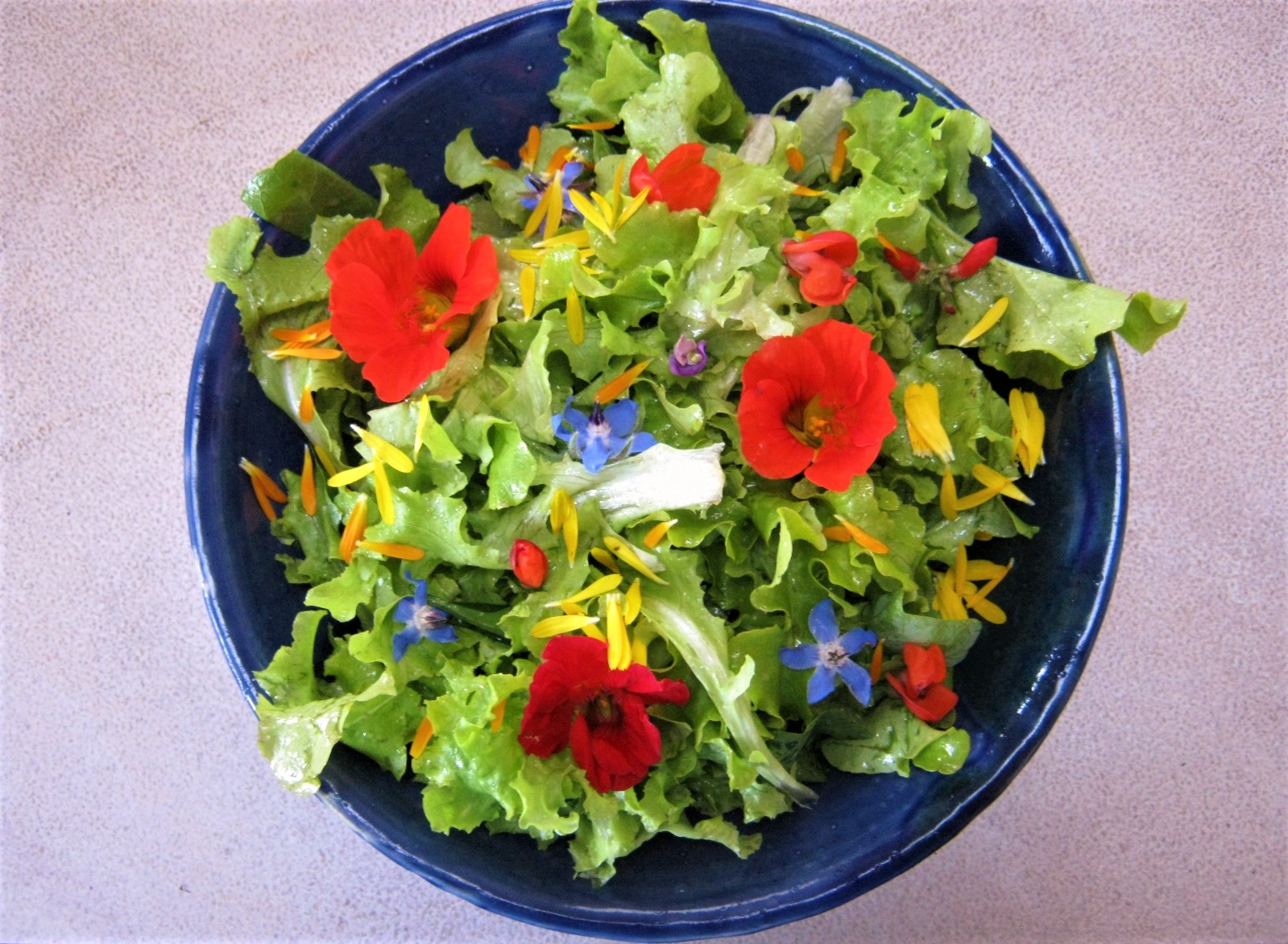
In fact, parsley and leafy salad greens do indeed get along very well. There is a lot more to salads than just iceberg lettuce and a few shredded carrots. You can add all kinds of interesting leaves to a salad—and not just leaves, flowers too.

That’s right, flowers. Here are just a few possibilities:
  • Calendulas (English marigolds)—the flower petals are a beautiful golden yellow; they used to be called “poor man’s saffron”
  • Nasturtiums - both flowers and leaves have a lovely peppery cress taste
  • Violas (wild pansies) - deep purple and yellow
  • Sweet violets - purple, with a delicate scent
  • Pea blossoms - white, with a fresh pea flavour
  • Bean blossoms - scarlet runner beans looks especially interesting
  • Borage - star-shaped sky-blue flowers; the fleshy leaves taste like cucumber
  • Rose petals - yes, they’re edible! I wonder if Sleeping Beauty knew that.

For leaf salads, you generally want to cut away anything that looks like you don’t want to eat it (rootlets, brown spots etc.); tear the leaves into bite-size pieces; wash them in a bowl of cold water until the water runs clear (I was taught to change the water at least three times, some say seven times); drain them well (a salad spinner is great if you have one, but just a strainer works too); and place them in a pretty bowl.

If you’re adding flowers, the preparation depends on the blossoms—washing them tends to squash them, I pick ones that are nice and clean, so they don’t need to be dunked in water. With some flowers (calendula or rose), you only pick the petals off and scatter them over the salad leaves, with others (pea blossom, borage) you use the whole blossom. Do whatever looks good and appetizing to you.
Now, when you’re making a lovely salad like that, do yourself a favor and don’t glob on thick blobs of bottled dressing. There is no need—making a salad dressing is the easiest thing. Here’s my recipe:

VERY SIMPLE VINAIGRETTE

Ingredients:
1/2 c. Oil (any kind—canola, sunflower, olive, almond, flaxseed—whatever you have on hand)
1/4 c. Lemon Juice or Vinegar (again, whichever kind you like—cider, wine, rice, balsamic, flavoured…)
1 tsp. Salt
1/2 tsp. Pepper
That’s it for the basic dressing—it works quite well as is—but there are endless possibilities for jazzing it up.

Optional Ingredients:

As I mentioned above, chopped parsley is one of the best herbs for adding flavour—or chives, green onions, dill, oregano … fresh or dried, either works, in whatever quantities you prefer. As a general guideline, start with about 1/2 tsp. dried herb or 1/2 Tbsp. fresh, and adjust it to taste.
If you prefer a creamy dressing, add 1/2 c. plain yogurt or sour cream.
For a bit more zing, 1 tsp. mustard, or 1/4 tsp. hot sauce or hot pepper flakes are great.

Steps:
Whisk everything together with a fork, whisk or blender.
Pour about 1/4 c. over the prepared salad and gently toss it.

Serve immediately so that you can get it eaten before the sorceress comes storming in and catches you devouring her rapunzels or parsley.

Let us know if you try this recipe!
We'd love to hear from you.
A.M. Offenwanger, contributing editor at Enchanted Conversation Magazine, is a writer, reader, blogger, and editor.
Follow her blog Amo Vitam
and on Twitter @amoffenwanger
and Facebook here

Cover Photo and Text Photos by A.M. Offenwanger
Rapunzel Cover illustration from Wikimedia Commons
Cover Layout by Amanda Bergloff @AmandaBergloff

March 2, 2018

FAIRY TALE FOOD: Peas & RECIPE OF THE MONTH: Split Pea Soup by A.M. Offenwanger

When I was a kid, peas came in cans. I’m sure you know the kind – pop the lid, drain the canning liquid, heat, and eat. They’re small, round, dull green, and above all, soft. Downright mushy, in fact.

The Princess and the Pea by Edmund Dulac

So given that background, Andersen’s tale of “The Princess and the Pea” or, as the original has it, “The Princess on the Pea”, presents a bit of a problem. To recap in case you’ve forgotten, it goes like this: Prince wants a real princess to marry; after long search, a bedraggled, rain-soaked girl turns up at the door of his kingdom (which is opened by the King himself – apparently the kingdom’s budget doesn’t run to employing a butler); the girl claims she’s a real princess; her preternatural princessly sensitivity is tested by means of a single pea under twenty mattresses and as many eiderdown featherbeds; the princess passes the test; the prince marries her, bruises and all; and the pea in question is ensconced in a cabinet of curiosities (presumably for future princesses to admire and aspire to).

Whatever else we know or don’t know about this pea, one thing is crystal clear: we’re not talking about a little mushy morsel from a can here (squish, splat, tiny stain under mattress, The End). Given the original publication date of Andersen’s version, it definitely isn’t a frozen pea, either - freezers were hard to come by in 1835. Besides, the pea would have thawed under the mattresses in very short order, so we’d be back to the stain-under-mattress scenario. A fresh one then? You could try it out – if you live in the Northern Hemisphere, March is prime time for planting garden peas; by June you would have your test subject. But I’ll save you the trouble and just tell you: even fresh peas are too soft for the purpose.


No, the pea the queen was using for her daughter-in-law selection process was neither of those. It was a dried pea, which is literally hard as a rock. I tested it: not with twenty mattresses (I’m not quite that enthusiastic), but a stack of a dozen or so fairy tale books with a combined weight of around fifteen pounds. The pea didn’t even crack.
Then I went one step further: I stuck the pea under the leg of my kitchen table – I can’t give you an actual weight for the table, but its legs are made from four-by-four timber, so you can estimate it. The pea held up. So, scientific study has established that one tiny, round, dried pea is capable of propping up a whole, heavy kitchen table with a fifteen-pound-stack of fairy tale books on top; twenty mattresses, twenty featherbeds, and one presumably slim princess should present no problem to this exemplary vegetable.

Peas do appear in other fairy tales, too – notably in the Grimms’ “Cinderella”, where she has to pick peas and lentils out of the ashes, but also in lesser-known tales like “The Hut in the Forest”, where the peas serve as (ineffective) trail markers similar to Hansel and Gretel’s bread crumbs. In most of these stories, peas are only incidental to the plot. But I just discovered another charming Andersen tale in which the peas are actually the protagonists: “The Pea Blossom” tells of five little peas in a pod who, upon ripening, meet with various fates out in the wide world. One of them sprouts and grows into a pea plant whose blossom cheers up a sick little girl so much she gets well.

I don’t eat peas out of a can anymore, and as a rule I don’t buy the whole dried ones for cooking, either (only for doing fairy tale experiments or making pea sprouts). But I do use split peas, which make an excellent soup for a day in which it “it thunders and lightens, and the rain pours down from the sky in torrents.” Here is the recipe:
INGREDIENTS:
2 cups split peas (1 lb.)
1 onion
3-6 carrots
2-3 celery stalks
8-10 cups water or stock (chicken or ham is good)
SALT and PEPPER to taste
Optional: a ham bone

STEPS:
1. Rinse the peas.
2. Peel and chop the vegetables.
3. Put everything together into a big soup kettle.
4. Simmer for 2-3 hours (or use a slow cooker, 8-10 hours on low) until the peas are soft and fall apart. Remove bone, if you're using one.
5. Blend everything with a stick blender or, if you don't have one or prefer a less smooth texture, crush vegetables with a potato masher.
Serve to princesses and other discerning friends on a cold, rainy day.

Let us know if you try this recipe,
or know of any other fairy tales with peas!
We'd love to hear from you.
A.M. Offenwanger, contributing editor at Enchanted Conversation Magazine, is a writer, reader, blogger, and editor.
Follow her blog Amo Vitam
and follow her on Twitter @amoffenwanger
and on Facebook here

Cover photo and text photos by A.M. Offenwanger
The Princess and the Pea cover illustration by Kay Nielsen
Cover layout by Amanda Bergloff

SITE DESIGNED BY PRETTYWILDTHINGS