navigation

Check out my Krampus Contest Winning Story posts!
Showing posts with label Krampus Contest Winning Story. Show all posts

January 1, 2013

Forest, Snow, Memory, By Patricia Scott


Editor's note: For our final winning work, Patricia creates a Krampus myth, complete with how he came to be with St. Nicholas. Every character like Krampus needs a mythology and Patricia provides a lyrical, detailed framework.

I was powerful once. I was a God to them. They feared me as much as they worshiped me, the ancient diety of their deep, mysterious forests. In the darkest reaches of the wildest over-growths I was rumored to dwell, waiting to slake my unending thirst on those unwary and foolish enough to risk my displeasure by forgetting to do me proper honor.

They would bring their offerings as far into the forests as they dared. Creeping as silently as they could, they would come upon a clearing in the forest that was still. Such were my altars, those quiet places where sunlight barely intruded. Standing in the center of those clearings where not even the sounds of the birds reached there would be a stump, black and gnarled, remnants of branches reaching unevenly to the obscured sky. Always, upon such stumps would be a perfectly level place, a single, unnatural shelf that had been carved by no man.

Then, they all knew such places were my cathedrals and they were awed. What match were spires of stone, created painstakingly by grunting, sweating men over the course of years when my groves seemed to have always been there. For all they knew, those clearings moved every night, the paths through the forest twisting in upon themselves in knots. People got lost in my forests all the time. People that they knew who had lived there and traveled them their entire lives.

Even as it grows, the forest consumes itself. That is the way of things. The old growth weakens and topples to the leaf-littered floor where it feeds the new shoots just emerging from the dirt. Everything happens in its time. The cycles build upon each other and continue ever onward.

As their new God rose up, he proved himself to be jealous, unwilling to share worshippers with any of those still dwelling amongst the peasants. While those who still wished to seek me dwindled, they never quite disappeared. They still had need to travel through my forests and, so, they found themselves with daily reminders of their old customs. Superstitions reign fiercely in isolation and dark. Away from the pretty colored glass and the golden embroidery of priestly robes, they believed more firmly in the dark mysteries surrounding them and less in that kind, benevolent God who wanted only their devotion.

Then, science came forth, chasing away those shadows as man sought dominion over nature. Mathematics and chemistry showed them enough of the ways of the cosmos to make them shed their belief like so much overused clothing. No longer did they come to my groves as supplicants. Science informed them that I, and so many of my brethren did not exist, that we never had, and that Fate and Grand Design could be explained in terms of simple processes. Men felt themselves as Gods as they pushed themselves to unlock the very secrets of the Universe.

As with all Gods whose devotees begin to flag, I began to weaken. Where once I could inspire obedience through the felling of a tree with a single thought, instead I could only snap twigs already lying on the forest floor. No longer did they fear, instead convincing themselves that what they heard was a deer or rabbit, perhaps a fox passing through the forest on their own way home.

The ancient, gnarled stumps became nothing more than curiosities, never more to inspire that crawling sense of fear and awe. They were as quickly bypassed as the sunlit margins of the woods. Prayers were not offered, tithes were not made. Trees were harvested with little thought to replacements being grown. I starved, growing less substantial with every passing season.

Then, one day, a man with hair and beard as white as snow came to one of my altars. He wore fur-trimmed robes and carried his wisdom as easily as the bit of bread and cheese he carried with him for his meal. I waited, far back in the undergrowth, to see what he wished.

“I know you're there,” he said, not loudly, but clearly enough to carry.

“What do you want, Nicholas?” for I knew him to be one of the men of that jealous, singular God.

“I have come to make you an offer,” Nicholas declared.

“An offer of what, pray tell? For years you have been encouraging my followers to desert me. Do you bring me death, then? Some small mercy to an already wounded and dying animal?” I could not help but ask.

“No. No. I do not believe that you are so far gone just yet. I offer you a way to save some bit of your strength. Belief in you will remain and you shall not perish from this existence.”

“And why, Nicholas, would you offer me such opportunity? Has your church weakened so with its demands of money from peasants?"

“The notions that fly into your minds, you devils,” Nicholas laughed, “No, no. God is good and the church thrives. The people need it. As for why, well, I believe that with your help, I can remake the world or, at least, this corner of it. As this new generation of children grow, they need reminded of what awaits them should they stray from the path of good. And that is where you come in.”

“I? What can I do to help your God take over a world he already owns?”

“Come with me on the eve of the Christ Child's birth. I mean to distribute some of the wealth of our church to the villages around us. They are in need of food and clothing and I shall journey forth to give them these. If you accompany me and frighten the children who behave poorly then, perhaps, they shall be better behaved in the future. I know what you are. You feed on fear and worry. I offer you a chance to feast again.”

“Feast? You offer to allow me to follow in your wake, groveling for mere scraps. Once, Nicholas, I had mighty feasts and nothing passed through these trees that I did not know. There was little that happened in my forests that I could not affect. I could fell them where they stood for setting foot in my forest and they all knew it,” I snarled.

“Yes. Once. You were a force to be reckoned with. No longer. Come then. Once a year, feast and be mighty again. Strike fear into the hearts of those who are blasphemous and unworthy and bring them back to my church. Remind them of the face of God and all that is holy.”

I wanted to turn my back on him. Desire coursed through me to simply walk away and trust in the length of memory to ensure my continued existence. Instead, I looked at my forest. Contours that had once been lush and green were beginning to wither and fade. My groves were no longer safe. While the heart of the earth beat beneath my hooves, the song of its life was growing fainter. My heart grew heavy as I thought, surrounded by the waning remnants of once perpetually verdant splendor. Finally, I turned to him.

“Let us strike your bargain, Nicholas,” I spat, “and we shall see how your feast suits me.”

He agreed.

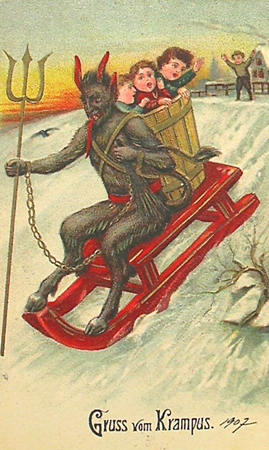
Thus, I found myself trotted out every year at Yuletide to be displayed as a dark figure as much ridiculed as he was feared. Never did I truly steal naughty children, though they were snatched up and pushed into the wicker basket strapped to my back, carried out into the snow to be striped once or twice for their insolence. Their fear tasted sweet, but it was no feast, not compared to what had been so long ago.

Nicholas began venturing farther afield to other villages. Word spread around us. Words became stories. Stories became legend. Soon, parents cautioned their children that if they misbehaved I would come knocking at the door and take them away. My forests faded from the story's memory, lost to the imaginings of dank and dismal caverns where I would work naughty children to their deaths. I grew stronger, though never quite strong enough to break the pact I had made with Nicholas in that grove all those ages ago.

The story of Nicholas spread. His generosity became kindness. His kindness became benevolence. The benevolence translated into jolliness. As their belief in him and his tradition of Yuletide gifts grew, the legend surrounding him became ever more fantastic. He became a saint, this man who struck deals with a forest devil. He began to live in the North Pole. He gained a workshop and a wife. Elves were gainfully employed in the arts of manufacture in order to ensure that demand was met.

I, with my dark skin and cloven hooves and horns atop my head, did not fit this new image of Christmas. Nicholas did not have need of me as he became the one to determine if a child received a gift or not. It seemed that the absence of the gift was punishment enough. Soon, they forgot to tell my part of the story at all and, once again, I began to fade.

The dusty tomes of historians and the fragile memories of antiquarians became my domain. I was relegated to the footnotes of histories, a curiosity to be considered quaint, though never charming. I became nothing more than a bit of trivia to be paraded about for the purposes of impressing those less well-informed or woefully under-read. There was nothing left of Nicholas's bargain but this lingering malaise. Science grew ever stronger and I feared that my only presence in the world would be brief mentions in text here or there in print nearly too small to see.

Recent years, however, have begun to prove otherwise. A strange fascination has arisen, spurred on by artists and writers. It seems that the old stories have begun to take root again. A stray image here, a tiny phrase mentioned in passing, a bit of half-heard song, and a spark takes hold. Suddenly, they are gripped by inspiration and they create. Oh, such things they create!

Where references cannot be found, they invent. My image draws them as it never did before and they have begun to remake me. As they are driven to tell my story and share my image, so does belief in me grow. They are building me as strongly as ever did my followers in the dim recesses of time. With each new piece, I feel power surge through me and I become more with each passing day.

An ancient, languishing God can still hope, and hope, I surely do. Creative works have a way of spreading and I have begun to reach those who would never have heard even the barest whisper of me in the past. So, I let them write and draw and paint. I draw nourishment from them as surely as they answer their own drives. And, someday, I will once again return to my forests. There, I shall wait in the deepest, darkest, most silent part, in the groves where sunlight barely penetrates. If you are brave enough to come looking, then, perhaps, you shall find me there.


Patricia Scott lives in the Midwest with a collection of dragons and what normal people insist is "too many books".  She writes a bi-monthly column, "Geek Girl Navigating the World" for boomtron.com and doesn't believe there is such a thing as too many books.


December 31, 2012

The Clever, Wicked Girl, By Jazz Sexton

Editor's note: Jazz takes on the idea of the pretty fairy tale heroine in this story and both subverts and endorses it. She also keeps the classic story form, while putting the reader at odds with the narrator, making for a fun, light-hearted read.
 
This story is true, though you might not want it to be. There once lived a girl whose father had died in the war, and whose mother was confined to bed, and so the girl took it upon herself to earn money for her mother’s medicine and food for her six younger brothers by weaving baskets. It was of the entire town’s opinion that this child was pure and selfless, but you and I know better when it comes to children. The girl found a wealth of business in town, especially at the market where merchants displayed fruits and trinkets inside wicker baskets. Besides the normal wear and tear, many merchants found their baskets burned to ashes overnight or termites hiding within the fruit, after eating through the baskets. This misfortune they could only blame on the scoundrels from whom they bought at wholesale, a town troublemaker, or plain bad luck. Never once did they suspect the golden haired girl who never ran out of customers in the small village.

As Christmas neared, the girl counted her money daily.

“By Christmas I will have enough for a ham and fixings, a little present for each of my brothers, and the strongest medicine from the apothecary for mother.” She was so pleased with herself that she decided not to create any mischief for the merchants that day. Tomorrow was always another opportunity. She ran home where her six brothers played in the yard.

“Quickly,”she said, pointing to the ground. “Line up here, and tell me what you want Santa to bring you this year. I will write your wishes down, and send them to the North Pole.”

So excited were the boys that they climbed over each other to be first in line, for never had they received anything for Christmas except a switch across their rumps when they made noise in church. Deservedly so, I should think. The boys asked for a roof without leaks so they wouldn’t wake up shivering in the night, a yo-yo for the youngest so he could make friends and impress them, and thread and needle to patch the knees in their britches.

The girl wrote down her brothers’ wishes and set off for the market. She had never planned to send the letter to Santa. He never brought them anything. Besides, now that she had her own money, she had no use of Old St. Nick. The girl hummed on her way to town, thinking of how happy her family would be. She wished for nothing for herself. To her, the best gift would be to see her mother well, if you can believe it from an arsonist like her.
 
The girl felt clever, conducting business as she did. She felt just in all of it, never destroying the baskets of the merchants who saw the least business.
 

As she approached the tailor’s shop where she intended to purchase the needle and thread, an odd looking man stepped round the corner. He wore a black day suit, and his hands and face were covered in brown fur.

Knowing it impolite to stare, the girl averted her eyes and continued toward the shop.

“Pardon me,” said a dark voice like gravel. It came from the strange looking man.

The girl turned and smiled at him. She stiffened at the sight of red horns protruding from his forehead, and the red tongue lolling from his jaws.

“Might you be the young lady who makes those wicker baskets all the merchants use?”

“I am that girl, sir.”

“Wonderful. I require a commission from you. I’ll need a basket, but not just any kind. This basket must be large at the top, and taper at the bottom. It must be long enough for something large to fit into with a lid that latches from the outside, and cannot be opened from the inside. Why, I’d say it should be large enough for you to fit into. Name your price, child.”

The girl thought it over, and came to a number three times her normal cost.

“Very well,” the strange man said. “I shall retrieve the product on Christmas Eve. Hold out your hand. I’ll pay you in advance.”

He counted out the coins to her, and disappeared back round the corner he emerged from. Now, unfortunately for people like us who wish to see such dishonest brats receive their comeuppance, this girl was not stupid. She knew the man covered in fur was Krampus playing a trick on her. The girl got straight to work on the basket, anyway, never one to go back on a business deal. On Christmas Eve, as she placed her mother’s and brothers’ presents by the hearth, Krampus appeared at her side. He no longer wore his suit. Now she saw his entire body was covered in fur. He held chains in his hands.

“Ah, yes, just as I wanted,” he said of the basket. “Just to make sure it is the right size, would you please step inside?"

The girl did as he bid her, and Krampus slammed the lid over her.

“You’ve been naughty,” he whispered through the wicker slats. “Tonight you shall burn just as the baskets you set on fire.” Krampus placed rope through the slats, and hoisted it on his back. “My, you are heavy,” he said as he went through town, laughing to himself.

As Krampus passed through the market, a mob of townsfolk met him at the center. With them was the girl who made the wicker baskets. Tears spilled over her sickeningly pink cheeks.

“That’s him! That’s the man I saw burn the apple seller’s basket.”

Krampus could not see how this was possible. He felt the weight of the girl on his back.

“That’s ridiculous. I’ve come to collect this girl for Santa. She’s been naughty all year. She’s the one who destroyed your baskets and stock for her own gain."

Krampus stood confident before the crowd. The apple seller looked from his charred basket to the sweet girl.

“Check his basket,” said the girl. “He made me make it so he could fill it with matches.”

She sniffed, and let out a sob for greater effect, the wretch. The townsfolk ripped the lid from Krampus’ basket. Inside they found matches and cans of gasoline just as the girl said.

That clever, wicked girl had created a trap bottom. She had slipped out and placed the matches and cans, which she hid in her apron, while Krampus wasn’t looking. Krampus found himself being chased down by the townsfolk with his own chains. They swung the chains and called for his head on a stake as Krampus fled to Santa’s sleigh.

The girl headed home, content that she had placed the blame on someone else. She resolved not to burn anymore baskets as she knew when to quit when she was ahead. The girl’s brothers cheered over their presents, and the sight of their joy was enough to cure their mother’s melancholy. With all the money she received from Krampus, the girl had enough to move her family to a bigger town where business was always steady. So this Christmas remember: you can even outsmart the devil so long as you are clever, and others think you are pretty enough to trust.

Jazz Sexton is on the Naughty list this year, but she doesn't mind. She blogs about books and writing at www.jazzsexton.com.


December 29, 2012

Bratty Tessa, By Candace L. Barr


Editor's note: Candace's story evokes the delightfully detailed tales of Hans Christian Andersen, when he writes about very bad children. And Tessa, the protagonist of this story, is a very bad girl, in a perfectly everyday sort of way. 

In a fairly typical house, in a fairly typical town, there lived a young girl named Tessa. She looked fairly typical and was a fairly typical bully. Her younger siblings lived in fear of her, conceding to her every whim lest they be punished. Her younger sister had already lost three dolls to the older girl's tantrums. The middle child, a boy, had a scar on his leg from a bad scrape he got when Tessa pushed him down.

The children in the rest of the neighborhood were similarly cowed. Tessa changed the rules of their games whenever she wished. She also broke those same rules with no consequence. Even some of the older children bent to her every wish and demand. They didn't have much choice; putting Tessa in her place would get them in trouble for picking on a poor little girl.

Her school life was fruitful due to others' labor. She cheated every chance she got and would often get classmates to do her homework for her. It wasn't that she needed it; if she had made the effort, she would have done very well on her own. For Tessa, effort was for those who hadn't found an easier way.

Tessa fell asleep on the eve of Saint Nicholas day warm and secure in her bed after a fairly typical day. She made fun of other children in school and even teased one girl to the point of tears then mocked her for being a crybaby. When asked why she would do such a thing, Tessa said, “Because I can,”which was her usual response. After school, she visited the candy store and walked out with all her money, plus several lollipops. She didn't pay if she could get away with just taking it. She had also talked back to her parents and had plans to cheat on her homework the next morning.

Learning the truth about Santa Claus had been freeing. Normally, for one month out of the year, Tessa would be on her best behavior. She once built the sweetest, kindest facade she could in hopes of tricking Jolly old Saint Nick into forgetting eleven months' worth of sins, but now she knew that no matter what she did, her parents would still have gifts waiting wrapped beneath the tree for her come Christmas morning. She even knew what some of them were since she had already rummaged through the closets and peeked.

No, she had nothing to fear, especially not from a creature she'd never even heard of. One who frightened children an ocean away.

She had stayed up past her bedtime that night despite her parents' insistence that she needed her sleep, and spent a good hour playing with the old toys she would soon push to the bottom of her toy box to make way for the new. When she finally got into bed, she was the right kind of tired to fall into a peaceful sleep.

That peace would not last very long, for a visitor was coming. Tessa slept through the sleigh landing on her roof and the footsteps down the hall. She slept through her door creaking open, and the blanket being lowered. What she couldn't sleep through was that first lash, which woke her up with a gasp. Her scream was muffled as she was taken out and up to the roof, where her punishment continued. Through tears she begged until the sobs took over, making her unable to speak. Her appeals to her parents went unheard as they passed the night deeply asleep. After what felt like an eternity, the little girl was stuffed into a basket on the sleigh, where she whimpered pitifully, barely aware of the others sharing her fate.

As the shock wore off and she was being flown through the night, she peeked out of the basket for the first time. From the back he looked hideous with his back covered in fur and his horns pointing back toward her. She spoke, her voice shaky and hoarse from crying. “H-hello?”

Her call went ignored. After a few moment she tried again, louder. “Ex-excuse me, but what are you?”

Her abductor answered without turning. Unfortunately she could not understand the words, his language foreign to her ears.

She tried again. “Could you p-please repeat that? I don't understand.”

A heavily accented reply came. “I am zee... helper to Saint Nicholas.”

In a return to her normal attitude, she scoffed. “You mean Santa Claus? There's no such thing! It's not even Christmas yet.”

“Not your Santa Claus! Of course he is not real! Saint Nicholas visits zee good little children tonight. Und I... zee bad.”

Tessa asked, “And what is your name?”

“I am called many things, but you may call me Krampus.” With that, the creature turned and revealed his face. A wide grin showed off his large, pointy teeth and a long tongue; his mouth looked perfect to devour children with. She could see how the horns grew from the top of his wildly furred head and curved back, reminding the girl of the Devil.

Tessa recoiled, then after a moment noticed other heads peeking out of the basket. Little eyes were wide with terror. Remembering the beating from earlier and fearing what would happen next, she swallowed a lump in her throat then asked, “Where are you taking us? ... Why?”

A short silence followed the question before the answer many ears were straining to hear was uttered. “Home vith me. Und because I can.” Krampus cackled, and the grating sound made all the children cover their ears and hunch themselves down in the basket.

The rest of the journey was relatively quiet as Krampus flew his sleigh to pick up the rest of his victims. None of the newer arrivals was brave enough to speak and spent most of the time sniffling and whimpering in the baskets, unaware of what was going on or why.

When they arrived at their destination, the children were led off the sleigh in a single file line, chained together and weeping. It would be hard to tell for sure, but Tessa may have wept the hardest.
Candace L. Barr is an avid reader, blogger, and lover of the dark and macabre. She has also been featured in Enchanted Conversation's Snow White issue. 

SITE DESIGNED BY PRETTYWILDTHINGS