navigation

Check out my Arthur Rackham posts!
Showing posts with label Arthur Rackham. Show all posts

October 12, 2021

Tricked, By DJ Tyrer


Editor’s note: The ease of language in this poem, and the way every word helps build a picture appealed to me. I can see every move and item. You’ll love it too. (Kate)

Not every maiden

Who accepted the strange little man’s deal

Discovered his name

(Rumpelstiltskin)

Facing the threat

Of losing their newborn child

The cruel imp spending their labour

Standing in the corner

Of the royal birthing chamber

Rubbing his hands with glee

But, a quick-thinking midwife

Can still provide a win

At the very last moment

Slipping a warming pan into blankets

Bundled up like a babe

Handing it over

“Is this what you wanted?”

“Yes! Yes!” clapping with delight

(Words seal the deal)

Mother sobs as the little man vanishes

Then, midwife smiles

Hands over newborn child…


***


DJ Tyrer is the person behind Atlantean Publishing, and has been published in issues of The Horrorzine, Illumen, Sirens Call, Spectral Realms, Star*Line, and Tigershark, and online at Lonesome October, and Three Drops from a Cauldron. SuperTrump and A Wuhan Whodunnit are available to download from the ATLANTEAN PUBLISHING website. He also has a personal BLOG.


***

Image by Arthur Rackham.


February 8, 2021

The Ballad of Bridget Cleary, By Natalie Huber Rodriguez


Editor’s note: For years, I have hoped that someone would tell the story of Bridget Cleary. I became interested in her story after reading “
The Cooper’s Wife is Missing,” which I recommend. To learn more about the Brigid Cleary story, go here. I know you’ll enjoy Natalie’s vivid, tragic, and absorbing poem. (KW)

Intro: This poem tells the bizarre and tragic story of Bridget Cleary, a real-life woman who lived in Ireland in the late 1800s. After passing through an area believed to be inhabited by fairies, she fell ill and was subsequently believed to be a fairy changeling by her family, who called upon not only the local doctor and priest for assistance, but also a man who was said to be a "fairy doctor," or folk healer, to try to get the real Bridget back from the land of the fairies.


***


I was no witch, I was no fairy.

I was just a lass from Tipperary.

A wife, a daughter, an honest wan

Until my flame of life was buried. 


Twas early March in the early morn

When my black stockings I did adorn

Myself with for to make my way

Through yonder glen, past the fairy fort.


Basket in hand, I moved with haste,

For I dared not tarry in this place 

Where fae and demon foul did lurk

In search of souls to lay to waste. 


I hurried on, wind at my back.

Bramble below my feet did crack

When hark! Another sound heard I

Behind me in the shadows black. 


With quivering hands, I turned my head

And lo, my heart did fill with dread. 

For there before me, beaming wide,

A face I knew to long be dead. 


With hair of gold and gown of white,

She walked with gait so feather light.

My Michael's mother, yes it was she,

Gone six years now one autumn night.


"Bridgie, love!" to me she cried.

"Come hither, my dearest son's fair bride!"

And to me, an open hand she held 

And beckoned me gaily to her side. 


With thundering heart, I turned and ran

And threw the basket from my hand.

Back through the glen, and nae once dared I

Look back upon that cursed land. 


At long last, back home I came

And fell upon the old doorframe.

And there I cried to the heavens above,

"God help this poor, unfortunate dame!" 


Out came my Michael, eyes wide with terror

At seeing me trembling, lying there.

Into his arms, he took me hence

To our chamber with greatest care.


There I remained for days in bed,

Struck with fever the doctor said. 

And then one day, to my dark room

The Father came with wine and bread.


"Bridget, child," said he to me.

"I've come to lend God's aid, you see.

For by His hand, you shall be healed."

And thus, my Michael did agree.


For hours and days o'er me he prayed

With Michael and kinfolk lending aid.

But try as they may, I healed not;

No, my affliction with me stayed.  


It was then that cousin Jack did tell 

Of how I’d fallen so unwell 

And called upon the cunning man 

To free me from this dismal spell. 


With herbs and piss and poker hot, 

They tormented me, but all for naught. 

And as I weakened more each day, 

With anguish my poor heart was wrought. 


Then one late night, as I lay frail,

In came Michael, his face struck pale.

"Ye are not my wife!" cried he.

"But a changeling who from Hell does hail!" 


Around my neck his hands did wrap.

"Where is my Bridget?! Bring her back!"

I tried to speak, but I could not

As with rough hand, my cheek he slapped. 


Into blinding rage he did descend 

And dragged me shrieking from my bed

To the fireside, unto the floor,

Cursing me as I wept and pled.


And then he took me by the mane

And held my face to burning flames.

"If ye won't bring my Bridget home,

Then back to Hell from whence you came!" 


Into the fire I then did soar

As he hurled me with a frightful roar.

"God in Heaven!" I screamed in vain

As I burned upon the Devil's own floor.


Twas many days hence when at last they found

My charred black form upon the ground

Within the very same fairy fort

Where otherworldly beings abound.


What happened then, no one can say

For sure of the events that day.

But if you go down to Ballyvadlea,

The children still sing as they play,


"Are you a witch or are you a fairy?

Or are you the wife of Michael Cleary?"

Who fifteen years in penance waits

For his bride who far away was carried. 


***

Bio: As a member of the Taino Indian Nation of the Caribbean, storytelling has always been a big part of Natalie's life and culture. This is what first inspired her to go into creative writing. She is also a socio-cultural anthropologist and folklorist and often writes fiction and poetry inspired by and including folkloric themes.  Previous publications include a contribution to the creative fiction anthology, A Multiplicity of Stories, for the University of Toronto and a thesis on Japanese folklore and mythology for George Mason University.  


***

Image is from Irish Fairy Tales, illustrated by Arthur Rackham. I think its squirmy madness represents the mood of this twisted tale.


***

If you enjoyed this poem, please consider becoming a supporter of our Patreon program. EC needs your help to offer more writing opportunities and great content.

December 28, 2020

When Is A Fairy Fair? By Priya Sridhar


Editor’s note: I love this deep dive into the good and bad aspects of the “the Folk.” And since “Diamonds and Toads” is one of my all-time favorite fairy tales, this essay was especially appealing to me, and I hope you’ll love it too. KW

The "fairies'" within fairy tales are often fascinating. Some are inspired by the Folk, those from European and Celtic mythology. Their favor can win you a happy ending where the hero or heroine marries into royalty and becomes royalty, no strings attached. Yet some curses can leave you lurching, or begging for any end regardless of if you end up burned or executed. “Diamonds and Toads” has the favor for the lead, who ends up with jewels every time she speaks, and the curse for her stepsister, who ends up starving in the woods in some versions. 

Fairies aren't always the benevolent butterflies with human bodies. (This image became popular in the Victorian era, to the point that two girls convinced Sir Arthur Conan Doyle that they had found fairies.) Instead, you have the luck of the draw. Some fairies will test you, with great rewards. Others won't care that your family insults them, and you receive the curse. The best solution is to be generous and polite. 


The Secret Test

Quite often, the fey in a tale will set certain tests. They will ask a child or an adult to do them a good deed. If the human succeeds, they will receive an award, usually gold. When a human is rude or selfish, however, they suffer a huge punishment. Obviously, the lesson is to be generous to strangers because you would rather avoid a curse if possible. 

The fascinating part is that the fairies tend to serve as a catalyst, rather than go through a character arc. When they give the blessing or cast the curse, the protagonist carries the weight of the story. The fairies tend to disappear, as the magic plays out within the established world.

Often, fairies disguise themselves as old beggars who are hungry or thirsty. They ask for a sip of water or a bite of food. The Fair Folk don't need food necessarily, but they want kindness. We never find out why, but the virtuous heroes never look a gift from a fairy in the mouth. (A sixth sense? KW) It's often best not to reject a fairy gift, or you may receive a curse in turn. Some Celtic folklore has tales of farmers being cursed when they don’t use a fairy gift. Always carry extra food, in case you meet a new friend on the road.

We see fairy tests most often with siblings and step-siblings. "The Golden Goose" features an old man that asks three woodcutters' sons for food when they have to go out. While the foolish third child is generous, his older brothers aren't. Both of them refuse to share their meal of bread and wine.

As a result, the brothers suffer serious injuries when trying to gather the necessary firewood. To add insult to injury, the third child is given sour milk and stale bread when he goes to chop up the lumber, but his food turns into a rich feast which he and the old man share. The old man also gives him a golden goose and warns him to take care of it. Then he vanishes into the dark.

The old man is a crucial catalyst for the story. He lets the youngest son set out with a reward, and fades into the cover of the trees. The youngest son carries the rest of the story, along with the goose, as numerous people try to take a feather or rescue those who subsequently get stuck to the bird. It's a choice that lies at the heart of the story. The old man didn’t care about the food. He wanted to see what someone would do in the darkness of the trees when no one else would see them.

Another wrinkle to the goose: anyone who touches it gets stuck to the feathers, and people who rescue them get stuck in turn. Either the fool doesn't notice the steadily growing line of people behind him or refuses to care. It’s certainly not a nice gift, for those unlucky enough to let the glinting gold tempt them. But Folk do not care if their gifts inconvenience others in the crossfire. 

Some versions of the tales go further. When a princess notices the youngest son, she laughs at the people stuck behind him and says she wants to marry him. Her father vetoes that since the boy is a woodcutter’s son and not nobility. The old man returns and says he’ll help the boy. When the king sets three impossible tasks—find a man who can eat a mountain’s worth of bread in a day, a thirsty person who will swallow enough wine to fill a cellar, and a boat that sails on water and land—the old man delivers on all three. He ensures that the king runs out of excuses to prevent the marriage.

Why does the old man come back? He says the boy was kind to him, and that it’s unfair of the king to set such conditions. The king got on the fairy’s bad side. He was lucky that the old man only fulfilled the tasks and didn’t go further. A little bit of kindness prevented more chaos from occurring.

On that note, some pragmatic people in fairy tales try to exploit this loophole. If they or a relative do a good deed for a fairy, the family can soon become rich. "Diamonds and Toads" as well as "Mother Holle" tackled this very issue when a greedy stepmother realizes that two girls with fairy rewards are more lucrative than one. Usually, she sets her blood daughter out to complete the same task that the stepchild accomplished, and the blood daughter ultimately cannot recognize a great task or do a kindness. This backfires horribly for her and her mother. 


"Diamonds and Toads" is the better-known of the two. The first girl speaks kindly and shares what she has with others. Her stepsister is rude and selfish, refusing to even give a stranger a sip of water. Both are asked by a strange lady or a soldier for a share of their water. The kind girl is blessed with diamonds, gold coins, and flowers coming out of her mouth, while the other releases hordes of frogs, snakes, and bugs when she speaks. One marries a prince, and the other tries to replace her, or dies alone in the woods. Either way, the tale doesn’t end well for the stepsister. 

The main difference is that the stepsister cannot be kind even for a selfish purpose. Her mother finds out about the girl receiving a gift and sends her outside, telling her explicitly to be nice and they’ll be rich for life. Yet the stepsister remains rude to an old woman when the latter asks for some water. She pays for it when the fairy vanishes—but promises that bugs and reptiles will come out of her mouth for every cruel world.

We get the contradiction of "moral deserts.”  Because the kind sister doesn't know she's getting a reward, her generosity is more meaningful since she expects and seemingly wants for nothing. Meanwhile, the selfish sister knows that she could receive a blessing of diamonds while refusing to consider that it may go the other way and leave her with snakes and frogs coming out of her mouth.   

Later versions would point out the problem with the blessing that the kind girl receives: anyone who can sprout jewels from her throat when she talks becomes a target for gold diggers. Flowers may also have poky stems and thorns. Her stepmother can confiscate the jewels and use them as currency, perhaps to buy tinctures or more water. This makes the girl more vulnerable than she was before, while her stepsister has often learned to be resourceful and use her gifts. 

The fairy at the well is a karma enforcer, but not a consistent one. She gives one girl a gift that is pretty on the surface but potentially consequential, and the other a curse that could lead to her death if others shun her. It is fairly arbitrary on a closer look, and a sign that not all tests have the same grades.

Curses Gone Wrong 

Then we have fairies on the other side who are not that nice. They don’t give the hero a chance to prove themselves because the said hero is a baby.

The most obvious cause would be “Sleeping Beauty.” In this story, the princess is only a baby when a fairy doesn’t get her proper invitation or hospitality at the christening. Other fairies are giving gifts, promising that she will be beautiful, musically gifted, and virtuous. This bad fairy decides to instill a curse that the princess will only live to be sixteen.


Doesn’t this seem to be harsh? If anything, the parents should be the ones cursed. They either forgot to send an invitation or failed to set out the proper silverware, depending on the versions that you read. Yet an innocent baby has to bear the burden that her parents failed with etiquette. 

Meanwhile, the good fairy left for her christening gift can’t undo the curse. She admits she is not powerful enough. Instead, death will become an enchanted sleep for one hundred years. It’s not good enough, but it will have to do. The good fairy watches over the princess, to protect her when the time comes. 

Later fairy tale rewrites and adaptations would justify why the good fairy could not remove the curse entirely. Robin McKinley had a bit to say about the subject, while Disney’s film established that Maleficent draws powers from the forces of evil while the good fairy magic can only be drawn from the heart. 

Then again, the wicked fairy is said to be unreasonable, especially as you go into later adaptations. You can’t break the curse, only meet your destiny on your terms. Sure enough, the princess does that. She finds an old woman weaving with a spindle, and desires to touch it. Cue the hundred years’ sleep.  

As soon as she casts the curse, the evil fairy disappears. She is once more a catalyst but still has a strong presence in the story. The kingdom fears what will happen when the curse comes to light, and the king orders all the spinning wheels burned to prevent that terrible fate. Her gift is not only mean, but it allows for no middle ground or amends. 

The good fairy also vanishes for a small portion of the story. Then she reappears after the princess touches the spindle, deciding to put the entire castle into an enchanted sleep until the curse is broken. She notes logically that everyone will outlive the princess otherwise. The decision has the added effect of ensuring a stable government is in place.

One concern emerges, however: no one in the castle consented to having an enchanted sleep. They didn’t do a good turn or a bad one to deserve it. Thus the injustice persists, that the good fairy’s motivation is about the princess’s comfort and not others wishes. 

If you are in a fairy tale, and you meet an old man or woman demanding water or food, it’s best to comply with them and abide by sacred hospitality. Share a meal with them, and accept their gifts. This will also protect any children you have, from potential curses. While the Folk are not fair, you at least have some warning on how to avoid disaster.

***

Bio: A 2016 MBA graduate and published author, Priya Sridhar has been writing fantasy and science fiction for fifteen years, and counting. Capstone published the Powered series, and Alban Lake published her works Carousel and Neo-Mecha Mayhem. Priya lives in Miami, Florida with her family.


***

Images, in order, are “The Golden Goose,” by Mabel

Lucie Atwell; “Toads and Diamonds,” by Gordon Laite; and “Sleeping Beauty,” by Arthur Rackham.

October 29, 2020

Throwback Thursday: A Tale of Two Witches, By Shannon Connor Winward


It’s Halloween week, so naturally, Throwback Thursday has to be a witch poem. This goes all the way back to 2012, and is filled with charm and magic. You’ll love it! The link is here.

***

Image is “The Witches Frolic,” by Arthur Rackham.

October 14, 2020

Bonus Story: Fallen Angel, By Henry Herz


Editor’s note: This light-hearted, funny take seemed like a perfect bonus story, and here it is. Henry’s mashup of “The Pied Piper” and one very hungry angel will lighten and brighten your day. Enjoy!


Pride and gluttony led to my fall from Heaven, but that is a tale for another time. Retaining my white wings proved a mixed blessing, as keeping them hidden quickly grew tiresome. I walked the Earth alone, posing as Evangeline the minstrel-mage. I traversed rarely trodden trails to astound audiences and, more to the point, to collect their coins with my spellbinding music, storytelling, and spell casting.


A chill wind blew, stinging my ears and tingling my fingers. I pulled my multicolored mantle tighter about my shoulders and tucked-in wings. Onward I trudged, following the lowering sun westward.


I topped a gentle rise and spied a distant but welcome sight—a small town, its far edge nestled against a dark green wood. Wisps of smoke from hearth fires beckoned. Ah, a chance to warm my chilly hands, rest my weary feet, and fill my empty belly, I thought. I could really go for a curd-smothered beef round between trenchers with a side of fried fingerling potatoes. But there's got to be a catchier name for that ... Encouraged by the prospect of sleeping on a bed rather than al fresco on unyielding earth, I marched without pause, reaching the hamlet before sunset. The peasants seemed pleasant enough, and I obtained without difficulty directions to the only inn. I strolled toward the central square, navigating narrow alleys lined by the wattle and daub buildings common to this province.


But I soon discovered this was like no other town I'd ever before beheld, for the villagers wore blue bretona birds on their heads like living hats! Being winged myself, birds held a special place in my heart.


The birds sang sweet songs. The villagers primped and played with their precious pets.


How odd! This place is for the birds. Hunger outweighed my curiosity, so I held in abeyance my questions about their feathered fedoras until I reached the thatch-roofed inn on the square. There I discovered that the innkeeper wore more than one hat, as they say, also serving as the mayor. I spent the last of my well-earned coins to secure dinner and a modest room for the night.


“I'll have a curd-smothered beef round with fried fingerlings,” I told the barkeep.


“A number seven!” he called to the kitchen. “Would you like an ale with that?”


***


I sighed contentedly after filling my belly. Tomorrow, I'll need to fill my purse. I yawned, eschewing the rustic evening entertainment scheduled for the common room, and climbed the rough-hewn wooden steps to my room. Miffed by the absence of a mint on my pillow, but exhausted by the day's exertions, I blew out the sputtering candle and sprawled on the straw-filled mattress.


***


I dreamt of traveling in style and comfort via a four horsepower luxury chariot. Intermittent slurping sounds woke me. I opened an eye. Beams of moonlight peeked through the curtains, softly illuminating the room. Spying nothing amiss and too tired to spare the noises any further thought, I fell back asleep.


***


I rose in the morn, refreshed though still sore from days of hiking. I longed for a chicken coop of fried eggs, a pigpen's worth of bacon, and a hot spring of coffee. But my empty purse dictated a different plan.


Tightening my belt, I resolved to remedy the situation by finding a suitable spot on the square to play for passersby and pass the hat, as it were. These rustic folk are probably starved for good music. Ugh, I've got to stop thinking about food.


I stepped outside and breathed the fresh morning air. But villagers scrambled helter-skelter in alarm like pheasants fleeing a flushing spaniel. For an overnight onslaught of scaly vermin now disrupted the harmony of the pastoral village. Who will toss me a coin now? I wondered. I'll have to don my thinking cap.


“Pestiferous niblings dug up my flowers,” complained one villager, pointing.


“You don't say?” I replied, having previously encountered such rodents of unusual shape in my travels.


“They snuck into cupboards and ate our berry scones,” cried another.


“Is that a fact?” I responded. That explains why they smelt of elderberries. My stomach growled, but my brow smoothed as a pecuniary opportunity percolated in my mind. Percolated? Stop thinking about breakfast!


“They gnaw my toys, and snurfle while I sleep,” wailed a small boy.


Hence the strange sounds last night. I nodded with empathy. Yet of all the niblings' offenses, the villagers deemed most egregious the torment of their bretona birds. For the tree-climbing niblings gave the birds no respite, chasing them from roosting spot to roosting spot, whether for play or as prey I could not say.


As the tally of complaints multiplied, the mayor strode into the square, huffing and puffing, shouting and pouting, but in no way improving the situation for his folk. He frequently fiddled with a large, lavishly plumed bretona bird perched atop his head. I've traveled enough to know a nincompoop when I suffer the misfortune of meeting one.


The grievances grew, and when he could countenance no more, the mayor stamped his feet. “Mifflestones! This will not do.”


Incompetent and irritable. I mentally doubled my de-infestation fee. “I am Evangeline the minstrel-mage. I can help,” I said to the mayor, throwing my hat into the ring, so to speak. I bowed my head with more manners than were due the backwater bumpkin.


The mayor did not reply. Instead, he ordered the villagers to build cages, weave nets, and set traps.


The indignities I endure to earn a meal. He lacks the courtesy to reply, the wits to solve the problem, and the humility to seek aid. He should hang up his hat as mayor. Biding my time, I made myself comfortable as a spectator. This will be entertaining.


The milking of animals, the planting of crops, and other daily routines ceased. But all to no avail. The pestiferous niblings dodged and evaded. The cages, nets, and traps remained empty. Shoulders slumped as the villagers resumed their regular duties.


The mayor's face reddened.


I stood. “I am Evangeline the minstrel-mage. I can help. Ridding towns of their troubles is old hat for me,” I said, pointing at a nibling preparing to nibble on a dozing dog's tail.


The mayor glared, but approached nonetheless. “What will my townsfolk think of me if I let a stranger solve our problems?” he replied rhetorically in a whisper, tilting his head toward the square.


I smiled, saying nothing. That you are not a prideful fool. Instead, you make clear that you possess the wits of a donkey's back end, but with less aesthetic appeal. I sighed. Oh, the indignities I endure to earn a meal. He won't be able to pull a solution out of his hat. Sooner or later he will bow to the inevitable and hire me. I mentally tripled my de-infestation fee.


After a pause, the mayor's face lit with an idea, possibly a rare experience for him. “Let us loose our woolyfloof herd to chase off the pestiferous niblings!” he cried.


At the drop of a hat, the dutiful villagers again ceased the milking of animals, the planting of crops, and other daily routines. They drove the woolyfloofs from their split-rail pens.


But the pestiferous niblings, while small in stature, possessed the tenacity of terriers. They bared their fangs, swiped with their claws, and snurfled most defiantly.


The larger but timid woolyfloofs bleated and fled pell-mell. Or was it helter-skelter? Higgledy-piggledy? I can never keep those straight.


The niblings resumed their depredations, while hapless villagers scrambled to recover their errant livestock. 


“Wobius!” they cried. “When shall we be free of the pestiferous niblings?”


Third time's the charm. “Shall I rid you of these rodents?” I hailed the mayor, spreading my arms.


Emotions played out on his face like a stage performance. Eventually, he grinned, which I found strangely disconcerting. “Very well. Name your price, minstrel.”


“I shall wipe out your pests in exchange for ... cue dramatic music ... your bretona birds,” I said, pointing at the one perched on his head. My fame would soar as the only minstrel this side of the Great River with a personal gaggle of bretona birds. Or was it a convocation? Parliament? Regardless, in a pinch they could serve as lunch. There I go again, thinking about food.


The mayor's eyes bulged, his fists trembled, and his face reddened further, if that were possible. With a visible effort of will, he gradually regained his composure. “A moment,” he sputtered, storming to the center of the square.


Townsfolk crowded round the mayor. They argued in heated whispers, casting glances at me. A lengthy debate ended with the mayor having the last word, a polysyllabic one at that, incrementally raising my estimate of his intelligence.


He approached me and doffed the bird from his head, cradling it with affection. “We cannot abide the pestiferous niblings. But bretona birds are cherished pets, dear to us as children. Will you accept a hogshead of pike as payment?” he asked, hat in hand, you might say. “Our pickled pike are the pride of the province!” he proclaimed.


I tilted my head but did not reply. That was far too low a price to dignify with a response, and in any event, fish, like this fool before me, tend to stink after a couple of days.


The mayor furrowed his brow. “How about a mule and cartload of woolyfloof milk, butter, and cheese? Is that not a valley of plenty for a humble bard?”


“Hmmf,” I grunted, scowling. A better offer, but still too stingy.


The mayor glanced back at the villagers, stared at his feet, and finally sighed in defeat. “Five splendificant rubies, the size of which are seldom seen?” he offered, touching the leather pouch at his belt.


The villagers gasped.


Now that's a horse of a different color. “Agreed. I shall face the mighty horde,” I declared, making the task sound far more daunting than it actually was. “Clear the square,” I shouted to the townsfolk with a grand sweep of my arm. The cut of my cloak rendered such gestures très dramatic.


The villagers' faces brightened at the prospect of the niblings' imminent removal. They hastened to comply. Many held their breath. A hush fell.


I strode to the center of the square and drew my sorciful flute with all the theatrics I could muster. I traced an orniculous symbol in the air. That would not aid my casting, but wizardry is 50% showmanship. I raised the instrument to my lips and played a dulcet canticle, followed by Bourée. The latter is not part of the spell, but the melody is always a crowd-pleaser.


At once, the niblings desisted their digging, forsook their foraging, and stopped their snurfling. Instead, they swarmed about me, drawn to the sweet sounds like hummingbirds to honeysuckle.


The villagers' eyes widened, their mouths agape.


I led the bespelled beasts out of the village, through shadowy woods to a distant glade. There they stayed.


I hummed a tune for my own amusement as I skipped back to the village, savoring the prospect of a lavish luncheon for their savior. The anticipation of a full belly raised my spirits considerably. But it turns out one should never count their birds before they hatch. Hmm. That's a catchy saying ...


“Huzzah! Hurray!” cheered the villagers. “Hats off to Evangeline!” They leaped and wept. They danced and pranced. They wirbilated in harmony with their beloved birds.


“The niblings shall vex you no more,” I declared. Cue dramatic music. “Now, fulfill your oath.”


“What now?” the small boy whispered to the mayor, unaware of my keen hearing. “You knew we had no rubies.”


The mayor turned to me. “Well, I um ... misspoke. Alas, we have no gems,” he said, holding up empty palms.


“Yet you kept that under your hat,” I growled. He suffers from pride and greed.


“How about ten woolyfloofs?” asked the mayor, pointing at a pen.


“That was not our accord,” I declared, putting my hands on my hips. “Beware. I will brook no betrayal. I wield great power.” … And responsibility.


“No one threatens me,” growled the mayor, clenching his fists. “Certainly not a white-haired mottle-mantled piper. The pestiferous niblings are gone. You may have woolyfloofs or nothing.” He turned and marched off.


He defrauds and derides me? I'm a friend of humanity, but even I have my limits. My face flushed.


The faithless villagers retreated from my baleful glare.


I would have swept out my flaming sword and separated his duplicitous head from his shoulders, but that sort of thing is frowned upon these days as too wrathful. Nor does it tend to encourage attendance at my musical recitals ... except by the teenagers, that is.


Again I drew my sorciful flute. I tapped a tree trunk two times and trilled a 'taliatory tune. The bretona birds flocked to me. Again I trod toward the tenebrous trees.


The villagers gasped. “Wobius! What have we done?” they cried at the sight of their poultry in motion. They wailed and flailed to no avail. For they would never again behold their beloved birds.


Far from the village, but no longer alone, I composed a new tune and sang with my flock. Or convocation? Parliament? In any event, it began thusly:


“If you fail to play it straight, you'll no longer wirbilate.


So, pay the angel, heed your words, and you won't lose your cherished birds.”


***


Bio: Henry Herz is the traditionally published author of 13 speculative fiction adult short stories, 11 children's books, and 3 children's short stories. He edited the dark fantasy anthology, Beyond the Pale. He blogs at HenryHerz.com


***


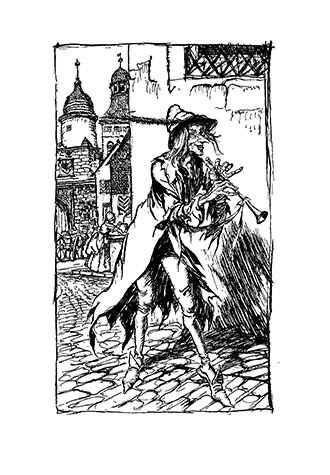
Image is The Pied Piper, by Arthur Rackham.

SITE DESIGNED BY PRETTYWILDTHINGS