navigation

Check out my EC Fairy Tale Project posts!
Showing posts with label EC Fairy Tale Project. Show all posts

January 6, 2020

Sun, Moon, and Talia, By Giambattista Basile

Stock photo
Editor's Note: Since I first read this version of "Sleeping Beauty," which I think of as the original (wiser heads might disagree), I view the slumbering princess in a totally different light. Basile's story, which he set down in the 1630s, is replete with crimes against Talia, crimes against human decency, and pretty much a gallery of human awfulness. Truly, I am perplexed as to why this early version of "Sleeping Beauty" fell out of favor with adults. (Note: When we are tempted to think our 21st-Century selves as above this form of entertainment, we need only think of slasher films. Modern adults have no corner on morally superior entertainment. KW) Kids, I can understand, but this dark tale has magic, sleep sex (shudder with the creepiness of it all!), a diabolical scorned wife, and a happy ending -- I guess.

I promise, read this and you'll never see a "Prince Charming" as any kind of rescuer of woman. (Update: Part of my goal when thinking and writing about fairy tales is to put to rest the myths about fairy tales. There seldom ever were any real "Prince Charmings" in fairy tales. And originally, they don't seem to have been written as symbols of desirable males. Rescue fantasies, to me, anyway, were a Disney thing. KW)

Update, 2020: This is the most popular post on EC of all time. Clearly, this old tale strikes a nerve. For those of you who wish to write new fairy tales, this is a great story to deconstruct.

There once lived a great lord, who was blessed with the birth of a daughter, whom he named Talia. He sent for the wise men and astrologers in his lands, to predict her future. They met, counseled together, and cast her horoscope, and at length they came to the conclusion that she would incur great danger from a splinter of flax. Her father therefore forbade that any flax, hemp, or any other material of that sort be brought into his house, so that she should escape the predestined danger. 

Unknown
 One day, when Talia had grown into a young and beautiful lady, she was looking out of a window, when she beheld passing that way an old woman, who was spinning. Talia, never having seen a distaff or a spindle, was pleased to see the twirling spindle, and she was so curious as to what thing it was, that she asked the old woman to come to her. Taking the distaff from her hand, she began to stretch the flax. Unfortunately, Talia ran a splinter of flax under her nail, and she fell dead upon the ground. When the old woman saw this, she became frightened and ran down the stairs, and is running still.

As soon as the wretched father heard of the disaster which had taken place, he had them, after having paid for this tub of sour wine with casks of tears, lay her out in one of his country mansions. There they seated her on a velvet throne under a canopy of brocade. Wanting to forget all and to drive from his memory his great misfortune, he closed the doors and abandoned forever the house where he had suffered this great loss.
After a time, it happened by chance that a king was out hunting and passed that way. One of his falcons escaped from his hand and flew into the house by way of one of the windows. It did not come when called, so the king had one of his party knock at the door, believing the palace to be inhabited. Although he knocked for a length of time, nobody answered, so the king had them bring a vintner's ladder, for he himself would climb up and search the house, to discover what was inside. Thus he climbed up and entered, and looked in all the rooms, and nooks, and corners, and was amazed to find no living person there. At last he came to the salon, and when the king beheld Talia, who seemed to be enchanted, he believed that she was asleep, and he called her, but she remained unconscious. Crying aloud, he beheld her charms and felt his blood course hotly through his veins. He lifted her in his arms, and carried her to a bed, where he gathered the first fruits of love. Leaving her on the bed, he returned to his own kingdom, where, in the pressing business of his realm, he for a time thought no more about this incident.

Frances MacNair
Now after nine months Talia delivered two beautiful children, one a boy and the other a girl. In them could be seen two rare jewels, and they were attended by two fairies, who came to that palace, and put them at their mother's breasts. Once, however, they sought the nipple, and not finding it, began to suck on Talia's fingers, and they sucked so much that the splinter of flax came out. Talia awoke as if from a long sleep, and seeing beside her two priceless gems, she held them to her breast, and gave them the nipple to suck, and the babies were dearer to her than her own life. Finding herself alone in that palace with two children by her side, she did not know what had happened to her; but she did notice that the table was set, and food and drink were brought in to her, although she did not see any attendants.

In the meanwhile the king remembered Talia, and saying that he wanted to go hunting, he returned to the palace, and found her awake, and with two cupids of beauty. He was overjoyed, and he told Talia who he was, and how he had seen her, and what had taken place. When she heard this, their friendship was knitted with tighter bonds, and he remained with her for a few days. After that time he bade her farewell, and promised to return soon, and take her with him to his kingdom. And he went to his realm, but he could not find any rest, and at all hours he had in his mouth the names of Talia, and of Sun and Moon (those were the two children's names), and when he took his rest, he called either one or other of them.

Henry M. Rheam
Now the king's wife began to suspect that something was wrong from the delay of her husband while hunting, and hearing him name continually Talia, Sun, and Moon, she became hot with another kind of heat than the sun's. Sending for the secretary, she said to him, "Listen to me, my son, you are living between two rocks, between the post and the door, between the poker and the grate. If you will tell me with whom the king your master, and my husband, is in love, I will give you treasures untold; and if you hide the truth from me, you will never be found again, dead or alive." The man was terribly frightened. Greed and fear blinded his eyes to all honor and to all sense of justice, and he related to her all things, calling bread bread, and wine wine.

The queen, hearing how matters stood, sent the secretary to Talia, in the name of the king, asking her to send the children, for he wished to see them. Talia, with great joy, did as she was commanded. Then the queen, with a heart of Medea, told the cook to kill them, and to make them into several tasteful dishes for her wretched husband. But the cook was tender hearted and, seeing these two beautiful golden apples, felt pity and compassion for them, and he carried them home to his wife, and had her hide them. In their place he prepared two lambs into a hundred different dishes. When the king came, the queen, with great pleasure, had the food served.

Marcus Stone
 The king ate with delight, saying, "By the life of Lanfusa, how tasteful this is"; or, "By the soul of my ancestors, this is good."

Each time she replied, "Eat, eat, you are eating of your own."

For two or three times the king paid no attention to this repetition, but at last seeing that the music continued, he answered, "I know perfectly well that I am eating of my own, because you have brought nothing into this house"; and growing angry, he got up and went to a villa at some distance from his palace, to solace his soul and alleviate his anger.

In the meanwhile the queen, not being satisfied of the evil already done, sent for the secretary and told him to go to the palace and to bring Talia back, saying that the king longed for her presence and was expecting her. Talia departed as soon as she heard these words, believing that she was following the commands of her lord, for she greatly longed to see her light and joy, knowing not what was preparing for her. She was met by the queen, whose face glowed from the fierce fire burning inside her, and looked like the face of Nero.

She addressed her thus, "Welcome, Madam Busybody! You are a fine piece of goods, you ill weed, who are enjoying my husband. So you are the lump of filth, the cruel bitch, that has caused my head to spin? Change your ways, for you are welcome in purgatory, where I will compensate you for all the damage you have done to me."

John W. Godward
Talia, hearing these words, began to excuse herself, saying that it was not her fault, because the king her husband had taken possession of her territory when she was drowned in sleep; but the queen would not listen to her excuses, and had a large fire lit in the courtyard of the palace, and commanded that Talia should be cast into it.

The lady, perceiving that matters had taken a bad turn, knelt before the queen, and begged her to allow her at least to take off the garments she wore. The queen, not for pity of the unhappy lady, but to gain also those robes, which were embroidered with gold and pearls, told her to undress, saying, "You can take off your clothes. I agree." Talia began to take them off, and with every item that she removed she uttered a loud scream. Having taken off her robe, her skirt, the bodice, and her shift, she was on the point of removing her last garment, when she uttered a last scream louder than the rest. They dragged her towards the pile, to reduce her to lye ashes which would be used to wash Charon's breeches.

The king suddenly appeared, and finding this spectacle, demanded to know what was happening. He asked for his children, and his wife -- reproaching him for his treachery -- told him that she had had them slaughtered and served to him as meat. When the wretched king heard this, he gave himself up to despair, saying, "Alas! Then I, myself, am the wolf of my own sweet lambs. Alas! And why did these my veins know not the fountains of their own blood? You renegade bitch, what evil deed is this which you have done? Begone, you shall get your desert as the stumps, and I will not send such a tyrant-faced one to the Colosseum to do her penance!"

Edward Burne-Jones
 So saying, he commanded that the queen should be cast into the fire which she had prepared for Talia, and the secretary with her, because he had been the handle for this bitter play, and weaver of this wicked plot. He was going to do the same with the cook, whom he believed to be the slaughterer of his children, when the man cast himself at his feet, saying, "In truth, my lord, for such a deed, there should be nothing else than a pile of living fire, and no other help than a spear from behind, and no other entertainment than twisting and turning within the blazing fire, and I should seek no other honor than to have my ashes, the ashes of a cook, mixed up with the queen's. But this is not the reward that I expect for having saved the children, in spite of the gall of that bitch, who wanted to kill them and to return to your body that which was of your own body."

Hearing these words, the king was beside himself. He thought he was dreaming, and he could not believe what his own ears had heard. Therefore, turning to the cook, he said, "If it is true that you have saved my children, be sure that I will take you away from turning the spit, and I will put you in the kitchen of this breast, to turn and twist as you like all my desires, giving you such a reward as shall enable you to call yourself a happy man in this world."

While the king spoke these words, the cook's wife, seeing her husband's need, brought forth the two children, Sun and Moon, before their father. And he never tired at playing the game of three with his wife and children, making a mill wheel of kisses, now with one and then with the other. He gave a generous reward to the cook, he made him a chamberlain. He married Talia to wife; and she enjoyed a long life with her husband and her children, thus experiencing the truth of the proverb:
Those whom fortune favors
Find good luck even in their sleep.

Artists are named  under their images in this post.

July 5, 2012

Rumpelstiltskin, By Jacob and Wilhelm Grimm

Editor's note: Poor old Rumpelstiltskin. In my book, he was more sinned against than sinning. He always just seemed like a lonely guy who wanted a child -- and really, how great would the greedy king and thoughtless miller's daughter be as parents? And the miller? A dolt. Everyone knows that you do not, do not, try to gain the attention of the greedy and powerful -- unless you are attempting a palace coup.

The miller was not up to anything like a palace takeover, but in any case, the brag about his daughter's alleged ability to spin straw into gold sets the whole story of "Rumpelstiltskin" motion. 

The king, even for a figure of power in a fairy tale, is notably greedy and cruel. Not only does he want all the gold he can get (which, admittedly, is a pretty common failing), but he threatens her with death if she fails to produce. The miller, meanwhile, is not seen to throw himself at the feet of the kind, begging for mercy for his daughter.

The miller's daughter is pretty vacant, in this version of the tale, and this version is a standard text. All she can do is cry. Then, she ultimately promises away one of the things the king would most want from her: His future child. Granted, she is scared, but surely, a man who would kill a woman who couldn't spin straw into gold would also kill her if she gave away his child -- but he'd probably torture her first. Perhaps she needed to think harder.

Rumpel is the only decent person in the story. He even gives the "heroine" a chance to keep her baby by guessing his name. And she cheats.

But you know that, because you already know the story. The Brothers Grimm version below is from 1922. 

What do you think of my surly take on this story? I say, "Team Rumpel!"

Charles Robinson

There was once a poor Miller who had a beautiful daughter, and one day, having to go to speak with the King, he said, in order to make himself appear of consequence, that he had a daughter who could spin straw into gold. The King was very fond of gold, and thought to himself, "That is an art which would please me very well"; and so he said to the Miller, "If your daughter is so very clever, bring her to the castle in the morning, and I will put her to the proof."

As soon as she arrived the King led her into a chamber which was full of straw; and, giving her a wheel and a reel, he said, "Now set yourself to work, and if you have not spun this straw into gold by an early hour to-morrow, you must die." With these words he shut the room door, and left the maiden alone.

There she sat for a long time, thinking how to save her life; for she understood nothing of the art whereby straw might be spun into gold; and her perplexity increased more and more, till at last she began to weep.

All at once the door opened, and in stepped a little Man, who said, "Good evening, fair maiden; why do you weep so sore?"

"Ah," she replied, "I must spin this straw into gold, and I am sure I do not know how."

Anne Anderson

 The little Man asked, "What will you give me if I spin it for you?"

"My necklace," said the maiden.

The Dwarf took it, placed himself in front of the wheel, and whirr, whirr, whirr, three times round, and the bobbin was full. Then he set up another, and whir, whir, whir, thrice round again, and a second bobbin was full; and so he went all night long, until all the straw was spun, and the bobbins were full of gold. At sunrise the King came, very much astonished to see the gold; the sight of which gladdened him, but did not make his heart less covetous. He caused the maiden to be led into another room, still larger, full of straw; and then he bade her spin it into gold during the night if she valued her life. The maiden was again quite at a loss what to do; but while she cried the door opened suddenly, as before, and the Dwarf appeared and asked her what she would give him in return for his assistance. "The ring off my finger," she replied. The little Man took the ring and began to spin at once, and by morning all the straw was changed to glistening gold. The King was rejoiced above measure at the sight of this, but still he was not satisfied, but, leading the maiden into another still larger room, full of straw as the others, he said, "This you must spin during the night; but if you accomplish it you shall be my bride." "For," thought he to himself, "a richer wife thou canst not have in all the world."

Charles Folkard

When the maiden was left alone, the Dwarf again appeared and asked, for the third time, "What will you give me to do this for you?"

"I have nothing left that I can give you," replied the maiden.

"Then promise me your first-born child if you become Queen," said he.

John Gruelle
The Miller's daughter thought, "Who can tell if that will ever happen?" and, ignorant how else to help herself out of her trouble, she promised the Dwarf what he desired; and he immediately set about and finished the spinning. When morning came, and the King found all he had wished for done, he celebrated his wedding, and the Miller's fair daughter became Queen.

The gay times she had at the King's Court caused her to forget that she had made a very foolish promise.
About a year after the marriage, when she had ceased to think about the little Dwarf, she brought a fine child into the world; and, suddenly, soon after its birth, the very man appeared and demanded what she had promised. The frightened Queen offered him all the riches of the kingdom if he would leave her her child; but the Dwarf answered, "No; something human is dearer to me than all the wealth of the world."

The Queen began to weep and groan so much that the Dwarf pitied her, and said, "I will leave you three days to consider; if you in that time discover my name you shall keep your child."

AH Watson

All night long the Queen racked her brains for all the names she could think of, and sent a messenger through the country to collect far and wide any new names. The following morning came the Dwarf, and she began with "Caspar," "Melchior," "Balthassar," and all the odd names she knew; but at each the little Man exclaimed, "That is not my name." The second day the Queen inquired of all her people for uncommon and curious names, and called the Dwarf "Ribs-of-Beef," "Sheep-shank," "Whalebone," but at each he said, "This is not my name." The third day the messenger came back and said, "I have not found a single name; but as I came to a high mountain near the edge of a forest, where foxes and hares say good night to each other, I saw there a little house, and before the door a fire was burning, and round this fire a very curious little Man was dancing on one leg, and shouting:

Warwick Goble
"'To-day I stew, and then I'll bake,
To-morrow I shall the Queen's child take;
Ah! how famous it is that nobody knows
That my name is Rumpelstiltskin.'"

When the Queen heard this she was very glad, for now she knew the name; and soon after came the Dwarf, and asked, "Now, my lady Queen, what is my name?"

First she said, "Are you called Conrade?" "No."

"Are you called Hal?" "No."

"Are you called Rumpelstiltskin?"

"A witch has told you! a witch has told you!" shrieked the little Man, and stamped his right foot so hard in the ground with rage that he could not draw it out again. Then he took hold of his left leg with both his hands, and pulled away so hard that his right came off in the struggle, and he hopped away howling terribly. And from that day to this the Queen has heard no more of her troublesome visitor.

Kay Nielsen

May 24, 2012

Snow White, By Jacob and Wilhelm Grimm, 1812 Version

Editor's Note: I've taught "Snow White," to college students and read countless submissions to EC updating it, and still, the tale enthralls me. It's been played with in so many ways and forms, for so long, I should be tired of the whole story. But how others see it still often surprises me. What's more, "Snow White," in this variant, is so very different from the pastel cypher of the Disney movie, that I never grow tired of remembering that Snow, in 1812, was a rule-breaking runaway.

As for Disney, while there is much good and bad I could say, and have said, about the 1937 movie classic, I must point this out: Much is written about how the mirror in Snow White" is the voice of male dominance and judgment. Yet, in most of the illustrations of the magic mirror before the movie, the queen's reflection is genderless or a some version of her own reflection. As far as I can tell, it became male with the Disney film. 

And the prince? Dear God! What a creep! In almost every version.

Once upon a time in mid winter, when the snowflakes were falling like feathers from heaven, a beautiful queen sat sewing at her window, which had a frame of black ebony wood. As she sewed, she looked up at the snow and pricked her finger with her needle. Three drops of blood fell into the snow. The red on the white looked so beautiful, that she thought, "If only I had a child as white as snow, as red as blood, and as black as this frame." Soon afterward she had a little daughter that was as white as snow, as red as blood, and as black as ebony wood, and therefore they called her Little Snow-White.

WC Drupsteen

Now the queen was the most beautiful woman in all the land, and very proud of her beauty. She had a mirror, which she stood in front of every morning, and asked:
Mirror, mirror, on the wall,
Who in this land is fairest of all?
And the mirror always said:
You, my queen, are fairest of all.
And then she knew for certain that no one in the world was more beautiful than she.
Now Snow-White grew up, and when she was seven years old, she was so beautiful, that she surpassed even the queen herself. Now when the queen asked her mirror:
Mirror, mirror, on the wall,
Who in this land is fairest of all?
The mirror said:
You, my queen, are fair; it is true.
But Little Snow-White is still
A thousand times fairer than you.
When the queen heard the mirror say this, she became pale with envy, and from that hour on, she hated Snow-White. Whenever she looked at her, she thought that Snow-White was to blame that she was no longer the most beautiful woman in the world. This turned her heart around. Her jealousy gave her no peace. Finally she summoned a huntsman and said to him, "Take Snow-White out into the woods to a remote spot, and stab her to death. As proof that she is dead bring her lungs and her liver back to me. I shall cook them with salt and eat them."

Maxfield Parrish
 
The huntsman took Snow-White into the woods. When he took out his hunting knife to stab her, she began to cry, and begged fervently that he might spare her life, promising to run away into the woods and never return. The huntsman took pity on her because she was so beautiful, and he thought, "The wild animals will soon devour her anyway. I'm glad that I don't have to kill her." Just then a young boar came running by. He killed it, cut out its lungs and liver, and took them back to the queen as proof of Snow-White's death. She cooked them with salt and ate them, supposing that she had eaten Snow-White's lungs and liver.
Snow-White was now all alone in the great forest. She was terribly afraid, and began to run. She ran over sharp stones and through thorns the entire day. Finally, just as the sun was about to set, she came to a little house. The house belonged to seven dwarfs. They were working in a mine, and not at home. Snow-White went inside and found everything to be small, but neat and orderly. There was a little table with seven little plates, seven little spoons, seven little knives and forks, seven little mugs, and against the wall there were seven little beds, all freshly made.

Snow-White was hungry and thirsty, so she ate a few vegetables and a little bread from each little plate, and from each little glass she drank a drop of wine. Because she was so tired, she wanted to lie down and go to sleep. She tried each of the seven little beds, one after the other, but none felt right until she came to the seventh one, and she lay down in it and fell asleep.
When night came, the seven dwarfs returned home from the work. They lit their seven little candles, and saw that someone had been in their house.

Artist: ??
 
The first one said, "Who has been sitting in my chair?"

The second one, "Who has been eating from my plate?"

The third one, "Who has been eating my bread?"

The fourth one, "Who has been eating my vegetables?"

The fifth one, "Who has been sticking with my fork?"

The sixth one, "Who has been cutting with my knife?"

The seventh one, "Who has been drinking from my mug?"

Then the first one said, "Who stepped on my bed?"

The second one, "And someone has been lying in my bed."

And so forth until the seventh one, and when he looked at his bed, he found Snow-White lying there, fast asleep. The seven dwarfs all came running, and they cried out with amazement. They fetched their seven candles and looked at Snow-White. "Good heaven! Good heaven!" they cried. "She is so beautiful!" They liked her very much. They did not wake her up, but let her lie there in the bed. The seventh dwarf had to sleep with his companions, one hour with each one, and then the night was done.

When Snow-White woke up, they asked her who she was and how she had found her way to their house. She told them how her mother had tried to kill her, how the huntsman had spared her life, how she had run the entire day, finally coming to their house. The dwarfs pitied her and said, "If you will keep house for us, and cook, sew, make beds, wash, and knit, and keep everything clean and orderly, then you can stay here, and you'll have everything that you want. We come home in the evening, and supper must be ready by then, but we spend the days digging for gold in the mine. You will be alone then. Watch out for the queen, and do not let anyone in."

Kay Nielsen

 The queen thought that she was again the most beautiful woman in the land, and the next morning she stepped before the mirror and asked:
Mirror, mirror, on the wall,
Who in this land is fairest of all?
The mirror answered once again:
You, my queen, are fair; it is true.
But Little Snow-White beyond the seven mountains
Is a thousand times fairer than you.
It startled the queen to hear this, and she knew that she had been deceived, that the huntsman had not killed Snow-White. Because only the seven dwarfs lived in the seven mountains, she knew at once that they must have rescued her. She began to plan immediately how she might kill her, because she would have no peace until the mirror once again said that she was the most beautiful woman in the land. At last she thought of something to do. She disguised herself as an old peddler woman and colored her face, so that no one would recognize her, and went to the dwarf's house. Knocking on the door she called out, "Open up. Open up. I'm the old peddler woman with good wares for sale."

Warwick Goble

 Snow-White peered out the window, "What do you have?"

"Bodice laces, dear child," said the old woman, and held one up. It was braided from yellow, red, and blue silk. "Would you like this one?"

"Oh, yes," said Snow-White, thinking, "I can let the old woman come in. She means well." She unbolted the door and bargained for the bodice laces.

"You are not laced up properly," said the old woman. "Come here, I'll do it better." Snow-White stood before her, and she took hold of the laces and pulled them so tight that Snow-White could not breathe, and she fell down as if she were dead. Then the old woman was satisfied, and she went away.

Nightfall soon came, and the seven dwarfs returned home. They were horrified to find their dear Snow-White lying on the ground as if she were dead. They lifted her up and saw that she was laced up too tightly. They cut the bodice laces in two, and then she could breathe, and she came back to life. "It must have been the queen who tried to kill you," they said. "Take care and do not let anyone in again."

The queen asked her mirror:
Mirror, mirror, on the wall,
Who in this land is fairest of all?
The mirror answered once again:
You, my queen, are fair; it is true.
But Little Snow-White with the seven dwarfs
Is a thousand times fairer than you.
She was so horrified that the blood all ran to her heart, because she knew that Snow-White had come back to life. Then for an entire day and a night she planned how she might catch her. She made a poisoned comb, disguised herself differently, and went out again. She knocked on the door, but Snow-White called out, "I am not allowed to let anyone in."

Jennie Harbour
 
Then she pulled out the comb, and when Snow-White saw how it glistened, and noted that the woman was a complete stranger, she opened the door, and bought the comb from her. "Come, let me comb your hair," said the peddler woman. She had barely stuck the comb into Snow-White's hair, before the girl fell down and was dead. "That will keep you lying there," said the queen. And she went home with a light heart.
The dwarfs came home just in time. They saw what had happened and pulled the poisoned comb from her hair. Snow-White opened her eyes and came back to life. She promised the dwarfs not to let anyone in again.

The queen stepped before her mirror:
Mirror, mirror, on the wall,
Who in this land is fairest of all?
The mirror answered:
You, my queen, are fair; it is true.
But Little Snow-White with the seven dwarfs
Is a thousand times fairer than you.
When the queen heard this, she shook and trembled with anger, "Snow-White will die, if it costs me my life!" Then she went into her most secret room -- no one else was allowed inside -- and she made a poisoned, poisoned apple. From the outside it was red and beautiful, and anyone who saw it would want it. Then she disguised herself as a peasant woman, went to the dwarfs' house and knocked on the door.
Snow-White peeped out and said, "I'm not allowed to let anyone in. The dwarfs have forbidden it most severely."

Jennie Harbour

"If you don't want to, I can't force you," said the peasant woman. "I am selling these apples, and I will give you one to taste."

"No, I can't accept anything. The dwarfs don't want me to."

"If you are afraid, then I will cut the apple in two and eat half of it. Here, you eat the half with the beautiful red cheek!" Now the apple had been so artfully made that only the red half was poisoned. When Snow-White saw that the peasant woman was eating part of the apple, her desire for it grew stronger, so she finally let the woman hand her the other half through the window. She bit into it, but she barely had the bite in her mouth when she fell to the ground dead.

The queen was happy, went home, and asked her mirror:
Mirror, mirror, on the wall,
Who in this land is fairest of all?
And it answered:
You, my queen, are fairest of all.
"Now I'll have some peace," she said, "because once again I'm the most beautiful woman in the land. Snow-White will remain dead this time."

Marianne Stokes
 
That evening the dwarfs returned home from the mines. Snow-White was lying on the floor, and she was dead. They loosened her laces and looked in her hair for something poisonous, but nothing helped. They could not bring her back to life. They laid her on a bier, and all seven sat next to her and cried and cried for three days. They were going to bury her, but they saw that she remained fresh. She did not look at all like a dead person, and she still had beautiful red cheeks. They had a glass coffin made for her, and laid her inside, so that she could be seen easily. They wrote her name and her ancestry on it in gold letters, and one of them always stayed at home and kept watch over her.

Snow-White lay there in the coffin a long, long time, and she did not decay. She was still as white as snow and as red as blood, and if she had been able to open her eyes, they still would have been as black as ebony wood. She lay there as if she were asleep.

Henry M. Rheam


One day a young prince came to the dwarfs' house and wanted shelter for the night. When he came into their parlor and saw Snow-White lying there in a glass coffin, illuminated so beautifully by seven little candles, he could not get enough of her beauty. He read the golden inscription and saw that she was the daughter of a king. He asked the dwarfs to sell him the coffin with the dead Snow-White, but they would not do this for any amount of gold. Then he asked them to give her to him, for he could not live without being able to see her, and he would keep her, and honor her as his most cherished thing on earth. Then the dwarfs took pity on him and gave him the coffin.

The prince had it carried to his castle, and had it placed in a room where he sat by it the whole day, never taking his eyes from it. Whenever he had to go out and was unable to see Snow-White, he became sad. And he could not eat a bite, unless the coffin was standing next to him. Now the servants who always had to carry the coffin to and fro became angry about this. One time one of them opened the coffin, lifted Snow-White upright, and said, "We are plagued the whole day long, just because of such a dead girl," and he hit her in the back with his hand. Then the terrible piece of apple that she had bitten off came out of her throat, and Snow-White came back to life.

She walked up to the prince, who was beside himself with joy to see his beloved Snow-White alive. They sat down together at the table and ate with joy.

Their wedding was set for the next day, and Snow-White's godless mother was invited as well. That morning she stepped before the mirror and said:
Mirror, mirror, on the wall,
Who in this land is fairest of all?
The mirror answered:
You, my queen, are fair; it is true.
But the young queen
Is a thousand times fairer than you.
She was horrified to hear this, and so overtaken with fear that she could not say anything. Still, her jealousy drove her to go to the wedding and see the young queen. When she arrived she saw that it was Snow-White. Then they put a pair of iron shoes into the fire until they glowed, and she had to put them on and dance in them. Her feet were terribly burned, and she could not stop until she had danced herself to death.

Creators of images are named directly beneath them.

Beauty and the Beast, the de Beaumont Version

Beauty and the Beast is the only "big" fairy tale I can think of that is about what happens after marriage. The best-known version was written by Jeanne-Marie Le Prince de Beaumont, an 18th-century teacher and writer who know a thing or two about truly beastly husbands.

Analyses of B&B are thick on the ground. I enjoy what Maria Tatar has to say in her must-read, The Annotated Classic Fairy Tales, but here is my own take: "Beauty and the Beast" is about the shock that takes place when two people marry and find the real person behind the love object. Granted, when de Beaumont wrote B&B, girls of "good" family (which would have been her kind of student), often still had arranged marriages, but love matches were becoming popular in all classes. Even in love-based marriages, including today's unions, once people marry, things change. I know many people who lived together before marriage, and to a person, they say that after they got married, things changed -- not necessarily in a bad way. But change they did.

In B&B we have a heroine who is smart, industrious and attractive. Our hero -- my favorite in all of fairy tales -- is no matinee idol, but he is kind, quiet, loving and really, really, really generous. I like them both. Some theories about "Beauty and the Beast" suggest that the "beastliness" in the story is about how Beauty feels when she first encounters sex. That's quite possible. Well-born young women of the 1700s were often shocked by the wedding night. Fair enough.

What surprises me is how rarely I see an analysis of the part of B&B that is about extended family and in-laws. Beauty's relationship with the Beast, indeed the Beast himself, almost dies because of competing loyalties. No man or woman in a romantic partnership should ignore his or her original family (provided they aren't beastly themselves), but potentially strong partnerships do founder on the rocks of family demands. Otherwise, why so many in-law stories?

What do you think?

And now, the story.


There was once a very rich merchant, who had six children, three sons, and three daughters; being a man of sense, he spared no cost for their education, but gave them all kinds of masters. His daughters were extremely handsome, especially the youngest. When she was little everybody admired her, and called her "The little Beauty;" so that, as she grew up, she still went by the name of Beauty, which made her sisters very jealous.

Anne Anderson
The youngest, as she was handsomer, was also better than her sisters. The two eldest had a great deal of pride, because they were rich. They gave themselves ridiculous airs, and would not visit other merchants' daughters, nor keep company with any but persons of quality. They went out every day to parties of pleasure, balls, plays, concerts, and so forth, and they laughed at their youngest sister, because she spent the greatest part of her time in reading good books.

As it was known that they were great fortunes, several eminent merchants made their addresses to them; but the two eldest said, they would never marry, unless they could meet with a duke, or an earl at least. Beauty very civilly thanked them that courted her, and told them she was too young yet to marry, but chose to stay with her father a few years longer.

Walter Crane


All at once the merchant lost his whole fortune, excepting a small country house at a great distance from town, and told his children with tears in his eyes, they must go there and work for their living. The two eldest answered, that they would not leave the town, for they had several lovers, who they were sure would be glad to have them, though they had no fortune; but the good ladies were mistaken, for their lovers slighted and forsook them in their poverty. As they were not beloved on account of their pride, everybody said; they do not deserve to be pitied, we are very glad to see their pride humbled, let them go and give themselves quality airs in milking the cows and minding their dairy. But, added they, we are extremely concerned for Beauty, she was such a charming, sweet-tempered creature, spoke so kindly to poor people, and was of such an affable, obliging behavior. Nay, several gentlemen would have married her, though they knew she had not a penny; but she told them she could not think of leaving her poor father in his misfortunes, but was determined to go along with him into the country to comfort and attend him. Poor Beauty at first was sadly grieved at the loss of her fortune; "but," said she to herself, "were I to cry ever so much, that would not make things better, I must try to make myself happy without a fortune."

Arthur Rackham


When they came to their country house, the merchant and his three sons applied themselves to husbandry and tillage; and Beauty rose at four in the morning, and made haste to have the house clean, and dinner ready for the family. In the beginning she found it very difficult, for she had not been used to work as a servant, but in less than two months she grew stronger and healthier than ever. After she had done her work, she read, played on the harpsichord, or else sung whilst she spun.

On the contrary, her two sisters did not know how to spend their time; they got up at ten, and did nothing but saunter about the whole day, lamenting the loss of their fine clothes and acquaintance. "Do but see our youngest sister," said they, one to the other, "what a poor, stupid, mean-spirited creature she is, to be contented with such an unhappy dismal situation."

The good merchant was of quite a different opinion; he knew very well that Beauty outshone her sisters, in her person as well as her mind, and admired her humility and industry, but above all her humility and patience; for her sisters not only left her all the work of the house to do, but insulted her every moment.

Artist: ?


The family had lived about a year in this retirement, when the merchant received a letter with an account that a vessel, on board of which he had effects, was safely arrived. This news had liked to have turned the heads of the two eldest daughters, who immediately flattered themselves with the hopes of returning to town, for they were quite weary of a country life; and when they saw their father ready to set out, they begged of him to buy them new gowns, headdresses, ribbons, and all manner of trifles; but Beauty asked for nothing for she thought to herself, that all the money her father was going to receive, would scarce be sufficient to purchase everything her sisters wanted.

"What will you have, Beauty?" said her father.

"Since you have the goodness to think of me," answered she, "be so kind to bring me a rose, for as none grows hereabouts, they are a kind of rarity." Not that Beauty cared for a rose, but she asked for something, lest she should seem by her example to condemn her sisters' conduct, who would have said she did it only to look particular.

The good man went on his journey, but when he came there, they went to law with him about the merchandise, and after a great deal of trouble and pains to no purpose, he came back as poor as before.
He was within thirty miles of his own house, thinking on the pleasure he should have in seeing his children again, when going through a large forest he lost himself. It rained and snowed terribly; besides, the wind was so high, that it threw him twice off his horse, and night coming on, he began to apprehend being either starved to death with cold and hunger, or else devoured by the wolves, whom he heard howling all round him, when, on a sudden, looking through a long walk of trees, he saw a light at some distance, and going on a little farther perceived it came from a palace illuminated from top to bottom. The merchant returned God thanks for this happy discovery, and hastened to the place, but was greatly surprised at not meeting with any one in the outer courts. His horse followed him, and seeing a large stable open, went in, and finding both hay and oats, the poor beast, who was almost famished, fell to eating very heartily; the merchant tied him up to the manger, and walking towards the house, where he saw no one, but entering into a large hall, he found a good fire, and a table plentifully set out with but one cover laid. As he was wet quite through with the rain and snow, he drew near the fire to dry himself. "I hope," said he, "the master of the house, or his servants will excuse the liberty I take; I suppose it will not be long before some of them appear."

John Batten


He waited a considerable time, until it struck eleven, and still nobody came. At last he was so hungry that he could stay no longer, but took a chicken, and ate it in two mouthfuls, trembling all the while. After this he drank a few glasses of wine, and growing more courageous he went out of the hall, and crossed through several grand apartments with magnificent furniture, until he came into a chamber, which had an exceeding good bed in it, and as he was very much fatigued, and it was past midnight, he concluded it was best to shut the door, and go to bed.

It was ten the next morning before the merchant waked, and as he was going to rise he was astonished to see a good suit of clothes in the room of his own, which were quite spoiled; certainly, said he, this palace belongs to some kind fairy, who has seen and pitied my distress. He looked through a window, but instead of snow saw the most delightful arbors, interwoven with the beautifullest flowers that were ever beheld. He then returned to the great hall, where he had supped the night before, and found some chocolate ready made on a little table. "Thank you, good Madam Fairy," said he aloud, "for being so careful, as to provide me a breakfast; I am extremely obliged to you for all your favors."

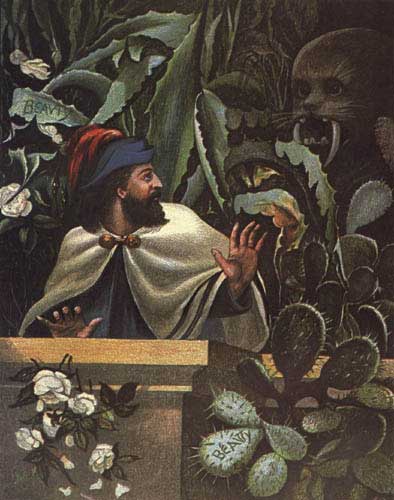
The good man drank his chocolate, and then went to look for his horse, but passing through an arbor of roses he remembered Beauty's request to him, and gathered a branch on which were several; immediately he heard a great noise, and saw such a frightful Beast coming towards him, that he was ready to faint away.

"You are very ungrateful," said the Beast to him, in a terrible voice; "I have saved your life by receiving you into my castle, and, in return, you steal my roses, which I value beyond any thing in the universe, but you shall die for it; I give you but a quarter of an hour to prepare yourself, and say your prayers."

The merchant fell on his knees, and lifted up both his hands, "My lord," said he, "I beseech you to forgive me, indeed I had no intention to offend in gathering a rose for one of my daughters, who desired me to bring her one."

Artist: ??


"My name is not My Lord," replied the monster, "but Beast; I don't love compliments, not I. I like people to speak as they think; and so do not imagine, I am to be moved by any of your flattering speeches. But you say you have got daughters. I will forgive you, on condition that one of them come willingly, and suffer for you. Let me have no words, but go about your business, and swear that if your daughter refuse to die in your stead, you will return within three months."

The merchant had no mind to sacrifice his daughters to the ugly monster, but he thought, in obtaining this respite, he should have the satisfaction of seeing them once more, so he promised, upon oath, he would return, and the Beast told him he might set out when he pleased, "but," added he, "you shall not depart empty handed; go back to the room where you lay, and you will see a great empty chest; fill it with whatever you like best, and I will send it to your home," and at the same time Beast withdrew.

"Well," said the good man to himself, "if I must die, I shall have the comfort, at least, of leaving something to my poor children." He returned to the bedchamber, and finding a great quantity of broad pieces of gold, he filled the great chest the Beast had mentioned, locked it, and afterwards took his horse out of the stable, leaving the palace with as much grief as he had entered it with joy. The horse, of his own accord, took one of the roads of the forest, and in a few hours the good man was at home.

His children came round him, but instead of receiving their embraces with pleasure, he looked on them, and holding up the branch he had in his hands, he burst into tears. "Here, Beauty," said he, "take these roses, but little do you think how dear they are like to cost your unhappy father," and then related his fatal adventure. Immediately the two eldest set up lamentable outcries, and said all manner of ill-natured things to Beauty, who did not cry at all.

Eleanor Vere Boyle


"Do but see the pride of that little wretch," said they; "she would not ask for fine clothes, as we did; but no truly, Miss wanted to distinguish herself, so now she will be the death of our poor father, and yet she does not so much as shed a tear."

"Why should I," answered Beauty, "it would be very needless, for my father shall not suffer upon my account, since the monster will accept of one of his daughters, I will deliver myself up to all his fury, and I am very happy in thinking that my death will save my father's life, and be a proof of my tender love for him."

"No, sister," said her three brothers, "that shall not be, we will go find the monster, and either kill him, or perish in the attempt."

"Do not imagine any such thing, my sons," said the merchant, "Beast's power is so great, that I have no hopes of your overcoming him. I am charmed with Beauty's kind and generous offer, but I cannot yield to it. I am old, and have not long to live, so can only loose a few years, which I regret for your sakes alone, my dear children."

"Indeed father," said Beauty, "you shall not go to the palace without me, you cannot hinder me from following you." It was to no purpose all they could say. Beauty still insisted on setting out for the fine palace, and her sisters were delighted at it, for her virtue and amiable qualities made them envious and jealous.

The merchant was so afflicted at the thoughts of losing his daughter, that he had quite forgot the chest full of gold, but at night when he retired to rest, no sooner had he shut his chamber door, than, to his great astonishment, he found it by his bedside; he was determined, however, not to tell his children, that he was grown rich, because they would have wanted to return to town, and he was resolved not to leave the country; but he trusted Beauty with the secret, who informed him, that two gentlemen came in his absence, and courted her sisters; she begged her father to consent to their marriage, and give them fortunes, for she was so good, that she loved them and forgave heartily all their ill usage. These wicked creatures rubbed their eyes with an onion to force some tears when they parted with their sister, but her brothers were really concerned. Beauty was the only one who did not shed tears at parting, because she would not increase their uneasiness.

W. Heath Robinson


The horse took the direct road to the palace, and towards evening they perceived it illuminated as at first. The horse went of himself into the stable, and the good man and his daughter came into the great hall, where they found a table splendidly served up, and two covers. The merchant had no heart to eat, but Beauty, endeavoring to appear cheerful, sat down to table, and helped him. "Afterwards," thought she to herself, "Beast surely has a mind to fatten me before he eats me, since he provides such plentiful entertainment." When they had supped they heard a great noise, and the merchant, all in tears, bid his poor child, farewell, for he thought Beast was coming. Beauty was sadly terrified at his horrid form, but she took courage as well as she could, and the monster having asked her if she came willingly; "ye -- e -- es," said she, trembling.

The beast responded, "You are very good, and I am greatly obliged to you; honest man, go your ways tomorrow morning, but never think of coming here again."

"Farewell Beauty, farewell Beast," answered he, and immediately the monster withdrew. "Oh, daughter," said the merchant, embracing Beauty, "I am almost frightened to death, believe me, you had better go back, and let me stay here."

"No, father," said Beauty, in a resolute tone, "you shall set out tomorrow morning, and leave me to the care and protection of providence." They went to bed, and thought they should not close their eyes all night; but scarce were they laid down, than they fell fast asleep, and Beauty dreamed, a fine lady came, and said to her, "I am content, Beauty, with your good will, this good action of yours in giving up your own life to save your father's shall not go unrewarded." Beauty waked, and told her father her dream, and though it helped to comfort him a little, yet he could not help crying bitterly, when he took leave of his dear child.

As soon as he was gone, Beauty sat down in the great hall, and fell a crying likewise; but as she was mistress of a great deal of resolution, she recommended herself to God, and resolved not to be uneasy the little time she had to live; for she firmly believed Beast would eat her up that night.

Walter Crane 2


However, she thought she might as well walk about until then, and view this fine castle, which she could not help admiring; it was a delightful pleasant place, and she was extremely surprised at seeing a door, over which was written, "Beauty's Apartment." She opened it hastily, and was quite dazzled with the magnificence that reigned throughout; but what chiefly took up her attention, was a large library, a harpsichord, and several music books. "Well," said she to herself, "I see they will not let my time hang heavy upon my hands for want of amusement." Then she reflected, "Were I but to stay here a day, there would not have been all these preparations." This consideration inspired her with fresh courage; and opening the library she took a book, and read these words, in letters of gold:
Welcome Beauty, banish fear,
You are queen and mistress here.
Speak your wishes, speak your will,
Swift obedience meets them still.
"Alas," said she, with a sigh, "there is nothing I desire so much as to see my poor father, and know what he is doing." She had no sooner said this, when casting her eyes on a great looking glass, to her great amazement, she saw her own home, where her father arrived with a very dejected countenance. Her sisters went to meet him, and notwithstanding their endeavors to appear sorrowful, their joy, felt for having got rid of their sister, was visible in every feature. A moment after, everything disappeared, and Beauty's apprehensions at this proof of Beast's complaisance.

At noon she found dinner ready, and while at table, was entertained with an excellent concert of music, though without seeing anybody. But at night, as she was going to sit down to supper, she heard the noise Beast made, and could not help being sadly terrified. "Beauty," said the monster, "will you give me leave to see you sup?"

Arthur Rackham 2

"That is as you please," answered Beauty trembling.

"No," replied the Beast, "you alone are mistress here; you need only bid me gone, if my presence is troublesome, and I will immediately withdraw. But, tell me, do not you think me very ugly?"

"That is true," said Beauty, "for I cannot tell a lie, but I believe you are very good natured."

"So I am," said the monster, "but then, besides my ugliness, I have no sense; I know very well, that I am a poor, silly, stupid creature."

"'Tis no sign of folly to think so," replied Beauty, "for never did fool know this, or had so humble a conceit of his own understanding."

"Eat then, Beauty," said the monster, "and endeavor to amuse yourself in your palace, for everything here is yours, and I should be very uneasy, if you were not happy."

"You are very obliging," answered Beauty, "I own I am pleased with your kindness, and when I consider that, your deformity scarce appears."

"Yes, yes," said the Beast, "my heart is good, but still I am a monster."

"Among mankind," says Beauty, "there are many that deserve that name more than you, and I prefer you, just as you are, to those, who, under a human form, hide a treacherous, corrupt, and ungrateful heart."

"If I had sense enough," replied the Beast, "I would make a fine compliment to thank you, but I am so dull, that I can only say, I am greatly obliged to you."

Beauty ate a hearty supper, and had almost conquered her dread of the monster; but she had like to have fainted away, when he said to her, "Beauty, will you be my wife?"

AL Bowley

She was some time before she dared answer, for she was afraid of making him angry, if she refused. At last, however, she said trembling, "no Beast." Immediately the poor monster went to sigh, and hissed so frightfully, that the whole palace echoed. But Beauty soon recovered her fright, for Beast having said, in a mournful voice, "then farewell, Beauty," left the room; and only turned back, now and then, to look at her as he went out.

When Beauty was alone, she felt a great deal of compassion for poor Beast. "Alas," said she, "'tis thousand pities, anything so good natured should be so ugly."

Beauty spent three months very contentedly in the palace. Every evening Beast paid her a visit, and talked to her, during supper, very rationally, with plain good common sense, but never with what the world calls wit; and Beauty daily discovered some valuable qualifications in the monster, and seeing him often had so accustomed her to his deformity, that, far from dreading the time of his visit, she would often look on her watch to see when it would be nine, for the Beast never missed coming at that hour. There was but one thing that gave Beauty any concern, which was, that every night, before she went to bed, the monster always asked her, if she would be his wife. One day she said to him, "Beast, you make me very uneasy, I wish I could consent to marry you, but I am too sincere to make you believe that will ever happen; I shall always esteem you as a friend, endeavor to be satisfied with this."

"I must," said the Beast, "for, alas! I know too well my own misfortune, but then I love you with the tenderest affection. However, I ought to think myself happy, that you will stay here; promise me never to leave me."

Beauty blushed at these words; she had seen in her glass, that her father had pined himself sick for the loss of her, and she longed to see him again. "I could," answered she, "indeed, promise never to leave you entirely, but I have so great a desire to see my father, that I shall fret to death, if you refuse me that satisfaction."

Edmund Dulac


"I had rather die myself," said the monster, "than give you the least uneasiness. I will send you to your father, you shall remain with him, and poor Beast will die with grief."

"No," said Beauty, weeping, "I love you too well to be the cause of your death. I give you my promise to return in a week. You have shown me that my sisters are married, and my brothers gone to the army; only let me stay a week with my father, as he is alone."

"You shall be there tomorrow morning," said the Beast, "but remember your promise. You need only lay your ring on a table before you go to bed, when you have a mind to come back. Farewell Beauty." Beast sighed, as usual, bidding her good night, and Beauty went to bed very sad at seeing him so afflicted. When she waked the next morning, she found herself at her father's, and having rung a little bell, that was by her bedside, she saw the maid come, who, the moment she saw her, gave a loud shriek, at which the good man ran up stairs, and thought he should have died with joy to see his dear daughter again. He held her fast locked in his arms above a quarter of an hour. As soon as the first transports were over, Beauty began to think of rising, and was afraid she had no clothes to put on; but the maid told her, that she had just found, in the next room, a large trunk full of gowns, covered with gold and diamonds. Beauty thanked good Beast for his kind care, and taking one of the plainest of them, she intended to make a present of the others to her sisters. She scarce had said so when the trunk disappeared. Her father told her, that Beast insisted on her keeping them herself, and immediately both gowns and trunk came back again.

Beauty dressed herself, and in the meantime they sent to her sisters who hastened thither with their husbands.

They were both of them very unhappy. The eldest had married a gentleman, extremely handsome indeed, but so fond of his own person, that he was full of nothing but his own dear self, and neglected his wife. The second had married a man of wit, but he only made use of it to plague and torment everybody, and his wife most of all. Beauty's sisters sickened with envy, when they saw her dressed like a princess, and more beautiful than ever, nor could all her obliging affectionate behavior stifle their jealousy, which was ready to burst when she told them how happy she was. They went down into the garden to vent it in tears; and said one to the other, in what way is this little creature better than us, that she should be so much happier? "Sister," said the oldest, "a thought just strikes my mind; let us endeavor to detain her above a week, and perhaps the silly monster will be so enraged at her for breaking her word, that he will devour her."

"Right, sister," answered the other, "therefore we must show her as much kindness as possible." After they had taken this resolution, they went up, and behaved so affectionately to their sister, that poor Beauty wept for joy. When the week was expired, they cried and tore their hair, and seemed so sorry to part with her, that she promised to stay a week longer.

Jennie Harbour


In the meantime, Beauty could not help reflecting on herself, for the uneasiness she was likely to cause poor Beast, whom she sincerely loved, and really longed to see again. The tenth night she spent at her father's, she dreamed she was in the palace garden, and that she saw Beast extended on the grass plat, who seemed just expiring, and, in a dying voice, reproached her with her ingratitude. Beauty started out of her sleep, and bursting into tears. "Am I not very wicked," said she, "to act so unkindly to Beast, that has studied so much, to please me in everything? Is it his fault if he is so ugly, and has so little sense? He is kind and good, and that is sufficient. Why did I refuse to marry him? I should be happier with the monster than my sisters are with their husbands; it is neither wit, nor a fine person, in a husband, that makes a woman happy, but virtue, sweetness of temper, and complaisance, and Beast has all these valuable qualifications. It is true, I do not feel the tenderness of affection for him, but I find I have the highest gratitude, esteem, and friendship; I will not make him miserable, were I to be so ungrateful I should never forgive myself." Beauty having said this, rose, put her ring on the table, and then laid down again; scarce was she in bed before she fell asleep, and when she waked the next morning, she was overjoyed to find herself in the Beast's palace.

She put on one of her richest suits to please him, and waited for evening with the utmost impatience, at last the wished-for hour came, the clock struck nine, yet no Beast appeared. Beauty then feared she had been the cause of his death; she ran crying and wringing her hands all about the palace, like one in despair; after having sought for him everywhere, she recollected her dream, and flew to the canal in the garden, where she dreamed she saw him. There she found poor Beast stretched out, quite senseless, and, as she imagined, dead. She threw herself upon him without any dread, and finding his heart beat still, she fetched some water from the canal, and poured it on his head. Beast opened his eyes, and said to Beauty, "You forgot your promise, and I was so afflicted for having lost you, that I resolved to starve myself, but since I have the happiness of seeing you once more, I die satisfied."

"No, dear Beast," said Beauty, "you must not die. Live to be my husband; from this moment I give you my hand, and swear to be none but yours. Alas! I thought I had only a friendship for you, but the grief I now feel convinces me, that I cannot live without you." Beauty scarce had pronounced these words, when she saw the palace sparkle with light; and fireworks, instruments of music, everything seemed to give notice of some great event. But nothing could fix her attention; she turned to her dear Beast, for whom she trembled with fear; but how great was her surprise! Beast was disappeared, and she saw, at her feet, one of the loveliest princes that eye ever beheld; who returned her thanks for having put an end to the charm, under which he had so long resembled a Beast. Though this prince was worthy of all her attention, she could not forbear asking where Beast was.

"You see him at your feet, said the prince. A wicked fairy had condemned me to remain under that shape until a beautiful virgin should consent to marry me. The fairy likewise enjoined me to conceal my understanding. There was only you in the world generous enough to be won by the goodness of my temper, and in offering you my crown I can't discharge the obligations I have to you."

Beauty, agreeably surprised, gave the charming prince her hand to rise; they went together into the castle, and Beauty was overjoyed to find, in the great hall, her father and his whole family, whom the beautiful lady, that appeared to her in her dream, had conveyed thither.

"Beauty," said this lady, "come and receive the reward of your judicious choice; you have preferred virtue before either wit or beauty, and deserve to find a person in whom all these qualifications are united. You are going to be a great queen. I hope the throne will not lessen your virtue, or make you forget yourself. As to you, ladies," said the fairy to Beauty's two sisters, "I know your hearts, and all the malice they contain. Become two statues, but, under this transformation, still retain your reason. You shall stand before your sister's palace gate, and be it your punishment to behold her happiness; and it will not be in your power to return to your former state, until you own your faults, but I am very much afraid that you will always remain statues. Pride, anger, gluttony, and idleness are sometimes conquered, but the conversion of a malicious and envious mind is a kind of miracle."

Margaret Evans Price


Immediately the fairy gave a stroke with her wand, and in a moment all that were in the hall were transported into the prince's dominions. His subjects received him with joy. He married Beauty, and lived with her many years, and their happiness -- as it was founded on virtue -- was complete.

 Artists' names are under images.

SITE DESIGNED BY PRETTYWILDTHINGS