navigation

Check out my Walter Crane posts!
Showing posts with label Walter Crane. Show all posts

January 15, 2014

Throwback Thursday: The Princess of Evighet, by Larry Stanfel

"The Masque of the Four Seasons, by Walter Crane, artmagick.com
Editor's note: For Throwback Thursday, here's a winning story from 1-15-14. It has so many great fairy tale elements! Read on.
This story evokes classic fairy tales, even if the heroine is a bit more detailed and lovable than most of her older sisters in fairy tales. There are foolish, indulgent parents, a nasty witch, a benign fairy, and a seeming happily ever after. Yet, as with the classic tales, one is left wondering: Would our heroine have had an even happier ever after without her "reward"? That's what made this story so intriguing to me. It leaves room for interpretation. 

A rather long time ago there was a Kingdom called Evighet, far across the sea from us, which had a King named Kaldric and a Queen, Agnetha. Their rule was entirely benevolent and gentle, and their subjects were happier than those in any other Kingdom.

There were so many holidays that the only way any work was accomplished was because the people were so pleased about the vacations, they endeavored mightily, then, to do exemplary jobs when there was no holiday. In Evighet they celebrated the birthdays of the King and Queen, the planting of crops, their harvest, the beginnings of each of the seasons, Independence Day (no one could remember when Evighet had not been independent), Veterans’ Day (no one could remember a war, either), Thanksgiving Days (twice annually, for there was much for which to be thankful), Christmas, New Year’s Day, Farmers’ Day, Tradesmen’s Day, and Labor Day. Royal Holidays were proclaimed practically extemporaneously, and one of them honored Bodrum Sebastovich, though no one could recall just who Bodrom Sebastovich had been.

The primary reason for the general gaiety of the King and Queen was that they loved to dance – solos, pas de deux with one another, and in groups of their subjects. All their many holidays featured morning columns of children dancing to the music of marching bands, afternoon entertainment
given by the very best dancers of the kingdom, and evening ballroom dances where everyone was welcome. For those no one paid any attention whatsoever to attire, and even Cinderella after midnight would have raised no alarm.

There was one thing lacking, however, that gave the King and Queen great sadness, which they showed only when they were alone and out of the public view; they had no child and were approaching the ages when people, even Kings and Queens, no longer had them. Accordingly, they prayed assiduously that they might be blessed with a son or daughter to become the next monarch and lead Evighet through another reign of joy and good fortune.

When it became known that their prayers had been answered, the production of next year’s calendars was halted, so that the birthday of the new Prince or Princess could be marked as another holiday. Expectedly, there were frequent celebrations, always with dancing, to herald the coming event, and the subjects rejoiced over Kaldric and Agnetha’s – not to mention their own – good fortune.

Princess Argentia, the Queen-in-Waiting and Heir Certainly, was born on the 21st of March, the first day of Spring that year, and the entire kingdom saw this as an auspicious omen of a new Spring for their beloved country. King Kaldric was excited that the family would have a brilliant little dancer. He was eager to teach her, but Queen Agnetha reminded him gently that first the little girl must be able to walk, so Kaldric contented himself with cradling his baby in his arms and dancing her
around one or another of the Royal Ballrooms.

He was absolutely certain that a Royal Princess would be walking by five months, but Queen Agnetha assured him that was fantastically early, even for a Royal Princess. The King said that he imagined he could wait another month, but again the Queen deterred him, though she could not dissuade him from declaring little Argentia’s half-birthday another national holiday and thus causing the calendars to be reprinted again; that is, re-reprinted. She would not, however, agree to a three-quarter birthday holiday, which is what the King wanted to declare when his hopes for the Princess’ first
steps were again frustrated at nine months. Gentle, wise Queen Agnetha explained to him that children do things at different ages and that he must not worry. Their daughter, for example, was speaking much earlier than most children.

On her first birthday, to her parents’ considerable delight, little Argentia took one, two unsteady steps and then fell plump! on her bottom but gave her parents a toothy grin and a happy giggle when she said, “Argentia walk, see?”

“That’s it,” pronounced the King with Royal Authority, but even Kings can err, and that was not it. For the next two months the Princess’ walking got no father advanced than a step or two concluded by a precipitant fall on her backside. The ebullient child was never unhappy or discouraged, though her father agonized and even her mother lost her Queenly composure and was showing signs of worry.

At 15 months the King summoned the Royal Physicians, who examined the Princess in every way known to their art and science at the time and finally submitted their report fearfully; there was something wrong with little Argentia’s leg bones. They had not grown strong enough or straight
enough to support her weight. Without metal braces, crutches, or both they predicted she would never walk! They prescribed exercises and special foods to strengthen her legs, and though the King and Queen followed their instructions to the letter, nothing availed.

Kaldric and Agnetha were devastated, of course, to learn that their beautiful little daughter was crippled and refused to accept the opinions of the Royal Physicians. Frantically, the King summoned ordinary physicians from his Kingdom, as well as Royal Physicians and ordinary physicians from other Kingdoms. While he paid much money for their ideas and treatments, the Princess could not walk.

By the time she reached 15 years, happiness had deserted the King and Queen, and, because of that, their subjects also suffered. No one celebrated the holidays, and the entire Kingdom, following the pattern of the Royal Couple, had stopped dancing so as not to disappoint the young Princess, who could not hope to follow their capers on her crutches. The Royal Ballrooms grew dusty from disuse, and cobwebs filled the corners there and wreathed the once-blazing chandeliers.

Happiness was not all that had forsaken Kaldric and Agnetha, for the years of medical expenses had seriously depleted the Royal Treasury. In fact, it then contained just two bags of gold, the Royal Household had taken to wearing patched finery, and the Royal Jewels had long since been sold to
foreign rulers.

Princess Argentia, nevertheless, had grown, except for her crooked legs, into a beautiful girl, and what was remarkable was that she had not lost her good cheer, effervescent laugh, and desire to do good. It was not uncommon, in fact, to see her struggling about on her crutches to help a sick or injured person among her father and mother’s subjects. Sight of brave Argentia always brought smiles to the faces and hearts of the people, though these were supplanted by tears when they watched the girl stump away on the wooden supports.

*     *     *

On a dark, high mountain that no mortal in Evighet had ever scaled lived a malignant witch named Bromalda, and she calculated that her time finally had arrived. Disguising herself as a well-dressed, kindly woman she paid the King and Queen a visit one day.

“I understand the Princess has been crippled from birth,” she said with solicitous unction, “and is unable to walk.”

“Alas, this is true,” confirmed her Royal Parents sadly.

“Well, I am here to help,” said Bromalda confidently.

“Everyone has tried,” they said, “and no one can help.”

“I have just returned from the far distant lands across the great sea to the East,” the witch lied, “and I have brought this!” with which pronouncement she produced from the depths of her cloak a flask of bright green liquid.

“What is that?” they naturally asked.

“What is that? Hmmpf, Your Highnesses. That is the most potent medicine ever distilled in the lands across the sea to the East. I have seen this magical elixir cause the blind to see, the deaf to hear, and cure victims of leprosy -- and worse.”

“What is worse than leprosy?” inquired the interested King.

“Far away in the East,” said Bromalda quickly, “many diseases are worse than leprosy, which is why the magicians and scientists there have developed this potion. Why, when I was visiting there, I was buried beneath an avalanche. Three days I was buried, and when I was dug out, I was declared dead.”

“No!” they exclaimed in concert.

“Yes, indeed, but this potion restored me to life. I spent all that I had to purchase these precious drops, but I gladly offer it to Your Highnesses – for no more than the price I paid.”

“How much was that?” Agnetha asked.

“A bag of gold.”

“Thank goodness,” breathed the Queen. “We have only two bags of gold remaining in the Royal Treasury.”

“Did I say one bag?” asked the devious Bromalda. “I meant two; after I reached home I had to send another bag for the second payment.”

“Oh, dear!” lamented the King. “All our money. And what if this, like all the other medicines, doesn’t --”

“We must do it, My Lord,” said the anguished Queen. It is our only chance to make Argentia walk!”

“I guarantee it; one hundred percent - certified,” vowed Bromalda falsely.

“Walk, yes, and then dance,” added the King with the old dream gleaming in his eyes. "Of course, we must try it.”

Accordingly, they promised the last of the kingdom’s resources to the evil Bromalda, who, as a bad witch, had less use for gold than desire to foment hurt and suffering. She proceeded to instruct them in the use of the magic potion, which was no more than vinegar, gooseberry juice, and a green dye
she had compounded in her cauldron.

“On the first night, give her one of the flask and have her sleep facing the South. On the second night administer another third and have her sleep facing North. Finally,” she said with dramatic effect in the spellbinding way witches have, “on the third night have her drink the last of the potion and sleep facing East. When she awakes she will be able to run and frisk like a new lamb!”

“And dance,” said the King, excitedly.

“Yes, but take care to follow the directions exactly. Each night, precisely one third the potion, no more, no less, and be certain she sleeps in those directions in the order I specified.”

“South, North, and East,” repeated Queen Agnetha, who, to be certain there was no failure, wrote down the invented information – much to Bromalda’s amusement.

“And,” she added with a flourish, “the child must not know what you are doing. Part of the magic requires that the patient be unaware that this liquid will cure her every disorder.”

The Lord of the Exchequer wondered mightily at handing over the last of the Treasury to a woman he had never seen, but when one works for a King and a Queen, he follows orders.

Bromalda was so pleased with herself that when she had the gold and no one else was about, she did a wild, witch dance to celebrate her success.

*     *     *

Without revealing what was afoot the excited Kaldric and Agnetha followed despicable Bromalda’s factitious instructions precisely. Princess Argentia protested strongly over the noxious taste of the green stuff, which she believed to be a new vitamin, and was baffled that her Lady-in-Waiting
spun her bed around like a top from one night to the next. “It is merely to capture all the healthy breezes, Your Highness,” explained her maid, who simply relayed what the Queen had told her.

On the morning after the third night her exuberant parents burst into Argentia’s room like two children on Christmas morning. “Come, Argentia; come walk to us,” they invited, and when she reached for her crutches, they qualified, “Without those, darling. You won’t ever need them again.”
Obeying the Royal Request, the brave Princess stood hesitantly, but when she let go the bed post and sought to walk to her parents, crumpled, fell, and cut her pretty cheek. The scene became one of a chaos of tragedy, sorrow, and regret when the King and Queen realized they had been duped
and, much worse than that, that their daughter would never, ever walk unassisted, let alone whirl in a spirited dance.

Argentia consoled them. “But Mother and Father, see! I am no worse than before.” She could not appreciate the Royal Poverty into which she was about to be plunged, but even if she had, the stalwart girl would not have repined. Governments in that place and time had yet to conceive the
strategies of creating new money – for mortals impossible in the case of gold – and borrowing from other lands; they continued to believe in paying for what they would get. In the case of that Kingdom, we see, there was no longer any means of payment.

Now, it must not be believed that Evighet was subject only to dark, poisonous influences like Bromalda. As in every place, there is saving good if one knows how to find it, or if it knows how to find oneself.

In a cave in a far-off forest of Evighet, Jetour, the Queen of the Fairies, held her Court amidst her attendants. At about this point in our tale Jetour’s Fairy Scouts, who had observed all the woe befalling Kaldric, Agnetha, and Argentia returned to report their news. Neither should it be supposed that they had demurred in returning or, in any way, depreciated the severity of the Royal Circumstances and poor Princess Argentia’s plight. No, as we know, Fairies live forever, so that 15 years is not a blink of an enchanted eyelash, and, moreover, they had a very large territory to monitor.

Like bees informing the hive as to their discoveries of blossoms, the Fairies did an intricate dance to convey their findings, and Jetour was at once enraged and heartbroken. She replied with a splendid, sublime dance that expressed all her sentiments and then convened her Court to confide to them her extensive, whispered plans.

Soon after, as the Princess was hobbling about the once-colorful garden in her tattered dress, a stooped, elderly woman with a cane approached and asked if she might have a drink of water. As was her habit, the excellent Argentia bade her sit, drew a cup of water from the well, and ministered
to her as if the visitor, not she, were the Princess. Such was the grace and love with which she treated each and every one of God’s creatures.

“Whatever has happened to your legs, Girl?” inquired the weary stranger between draughts of water. Old and crippled as I am, I can walk better than you. Have you fallen off a horse or down a hill?”

“Oh, no, M’am,” answered the Princess politely. “I was born this way. I have never been able to walk.”

“I see,” said the old woman thoughtfully. “Then you must have grown very bitter about your handicap. Looking all around you, you can see people, every one of whom moves better than you. Limping around with this cane, I feel bitter myself at times – most times. Yes, I would guess you are very bitter, indeed.”

“Oh, no, M’am, not bitter,” answered Argentia with incredulity that anyone would think so. "I do get around, you see; on these two, wooden legs. I think perhaps that I have been very lucky. Yes, lucky,” she said contemplatively.

“Lucky?” said the old woman with a snort. “How can you say that when you can’t run and climb and skip like other children your age?”

“I am lucky, M’am, because it has made me a better person.”

“Why, how better, when you can’t climb a mountain path or swim in a warm lake?”

“Ma’m, it is because I can’t do those things that I give such thanks for what I can do.  If I were running up a trail or across the garden, I might miss the calls of the birds, which I prize and dearly love. If I swam in the lake, I would frighten away the poor fish, whereas now, I can sit and watch them swim and play. If I had better use of my legs, I might not take such happiness from the sight of a beautiful sunset or the sound of a wonderful melody. The smell of juniper berries is like medicine to me, and when my cat licks my fingers – my sense of touch has grown so much stronger. Yes, walking is only one capability in a world exploding with beautiful things. I believe I have been lucky.”

“I see.”

“And it is more than just compensation with one gift for the loss of another. Doing without something, something important to others, and suffering pain in my twisted legs has been good for me. Yes, good. It makes things like eating only bread and porridge for dinner and wearing worn-out, patched dresses a pleasure by comparison. If I could walk and run, those things would be difficult to bear. Yes, but as it is …”

“What?”

“I do have one regret.”

“Aha!” sprang the old woman on her admission. “I knew it.”

In this condition a hurt I cause two other people, and, indirectly, the whole Kingdom.”

“A whole Kingdom? Whatever can your legs have to do with an entire Kingdom? Surely you exaggerate, Girl” the old lady proclaimed skeptically.

“It is just that my father and mother so want me to dance. They adore dancing, and because I cannot even walk, they suffer terribly. They suffer so much they have bankrupted themselves so that I might walk and someday be able to dance with them. And here I sit or wobble on these sticks. It is not bad for me, only them.”

“You are exceedingly odd, young lady. How can it be that your inability to dance and your parents’ regrets ruin the whole Kingdom of Evighet? Surely you jest with me. What is your exalted station in life?”

“Not exalted, good Madame. I am simply a poor Princess in a poor kingdom. Because my parents are so aggrieved, the whole kingdom is melancholy and poor.”

“Kingdom? Princess? You are a Princess? Your parents are King Kaldric and Queen Agnetha?”

“Yes,” answered Argentia shyly.

As if to affirm her reply, just then the King and Queen entered the garden. “And who might you be?” the King inquired of the stranger.

“Just a poor traveler, My Liege,” said the old woman with bows to both of them.

“You have been talking to the Princess?” asked the Queen, always swift to protect her daughter.

“Indeed I have, Your Highness, and may I say that this young person is wise and kind beyond her years. She has suffered much, I know, and yet she thinks not of herself but only of others and considers her lot in life a lucky one. She will make a fine and noble Queen one day.”

“Yes, we are proud of her goodness and love her very much,” said Kaldric.

“Still,” reflected the old woman, “it is a bitter shame, I find,  that her legs do not allow her to walk and to run and to … dance … possibly?”

“Yes,” said the King somberly. “And we have given much to restore her to health.”

“We have given everything,” corrected Agnetha with sincerity.

“Then it is high time you were all rewarded for your patience and sacrifice,” said the old woman with regal judgment herself. Saying thusly, she drew herself up, threw off the black cloak and cap, dropped the cane, and revealed herself to be Jetour, the Fairy Queen, attired in a tutu of purest silver and wielding her wand!

“Oh, my!” exclaimed the Princess.

“By heaven!” proclaimed the King.

“The Fairy Queen!” breathlessly spoke Queen Agnetha, who would have recognized her immediately even without her resplendent wand and dancing costume.

“And now, we must see to those legs,” decided Jetour with authority.

“Perhaps they have only been resting to gain strength these many years.” With a flourish she tapped each of Argentia’s knees with her wand, and the girl immediately cast away her crutches and took one, two, three, four, five careful, strong steps to her parents, who were beside themselves with
joy and embraced her tearfully. With the merest wave of her wondrous wand in either direction, Jetour summoned her Fairy Escort. “Now, good Fairies, do you suppose you might assist Princess Argentia to show us what she has always known how to do but for which only recently got the opportunity?”

The company of Fairies immediately surrounded the Princess, so that she was quite invisible for a moment, and when they stepped back, Argentia stood the most lovely of all Princesses in a glistening, alabaster tutu.

“Now, Dear Princess, give us all a lesson in dance,” encourage Jetour, and Argentia, with her suddenly beautiful and powerful legs, proceeded to fill the space with the most remarkable turns and leaps and spins and balances anyone present had ever seen. Jetour and her Court joined in the dance,
which was most spectacular.

When Argentia paused, the King and Queen each took one of their daughter’s hands, and all three offered Jetour their most profound, eternal, not to mention weeping, gratitude.

“Wait!” spoke Jetour peremptorily, as befits a Queen. “There is a matter still undone,” and she pointed a commanding finger into the distance. Her companion Fairies immediately flew from sight and almost instantly reappeared with evil Bromalda and the two sacks of gold in tow. “So, Bromalda,” said Jetour menacingly, “up to your old tricks again?”

The witch fell at Jetour’s feet and pled, “Forgive me, Fairy Queen. It was only a little mistake.”

“Little! Look at the noble Queen and King – nearly in rags. Look at the poor dress the Princess was forced to wear, and worst of all, bad witch, was to elevate the hopes of loving parents only to dash them to wretched shards.”

“Oh, please! Mercy, Queen Jetour! Mercy!”

“Bromalda, I have been thinking that perhaps you would like to spend a thousand or so years as an octopus, far beneath the seas where you can do no harm. Yes, that sounds about right, doesn’t it?” to which question her Fairy Court gave nodding and enthusiastic assent.

“No, please, Queen Jetour!” begged Argentia, interposing herself between the vengeful Fairy and the wretched Bromalda. Be merciful to her! Not such a terrible punishment! Please!”

“So, you even have the love to beg for the one that hurt you so deeply. What remarkable virtue, my dearest child. Very well, Bromalda,” she said angrily with blazing eyes and threatening wand. “The one you cheated and mistreated so wantonly has saved you. Look around you! Your cruelty and
theft have helped macerate this poor garden into a desert. Your punishment shall be to work here from morning to night every day for a hundred years. If it does not become the loveliest garden in all the world, and if you are ever guilty of a second’s mischief, then you had best prepare for
eight wet arms and a very long vacation among the rocks at the bottom of the ocean. Is that understood?”

“Yes,” wept Bromalda pitifully.

“Yes, what?”

“Yes, my Queen Fairy.”

“And do you imagine you should be thankful to the one that has saved you from my just punishment?”

Bromalda crawled to Argentia’s feet and kissed each of her dainty, satin dancing shoes. “Oh, thank you, Princess! Thank you!”

“Well, then,” resumed Jetour, “you had best go fetch the tools and the seeds and wheelbarrows and get to work, hadn’t you?”

“Yes, Fairy Queen.”

“Yes, indeed. You’ve had nearly a half-day off today. You might say your sentence has been commuted for the good behavior you will doubtless exhibit from this day forward.”

“Yes, my Fairy Queen.”

Jetour had only to point a finger imperiously, and Bromalda scrambled to her feet and ran to find the garden implements. “And, Bromalda?” added Jetour, whose words stopped the witch in her tracks.

“Yes, Fairy Queen?”

“I will be watching you,” after which ominous promise Bromalda scampered off to begin her century of work.

Then one Fairy danced up to whisper in Jetour’s left ear and another, into her right. Looking surprised, Queen Jetour said humbly, “Yes, I am growing forgetful. There are still matters unresolved. Am I becoming too old for my job?” The Fairies only shook their heads in answer, for when one works for a Queen, one learns how to respond.

“Yes, King Kaldric and Queen Agnetha, while we have salvaged most of the gold Bromalda extorted from you, you are still very, very, very far below the wealth Evighet once owned. Your whole kingdom is in dissolution because of the financial crisis over the Princess’ illness. Oh! How I wish
I had come sooner, and I promise to watch more carefully in future. Certainly,” she laughed heartily and aside, “I must keep tabs on the new Royal Gardener, mustn’t I? You have emptied the Royal Treasury in order to cure your beloved daughter, so I must see to it that a deposit is made to
your account.”

“No, Queen Jetour,” said the King and Queen in supplication. “You have done all for which we prayed. We shall build up our resources, and the kingdom will thrive again. Please! You are already too generous. What can compare in value to the health of our daughter? You have done too much
already.”

“Well,” said Jetour thoughtfully, “perhaps Fairies and mortals do reason differently.” Here Kaldric and Agnetha smiled briefly at winning their point. “But Fairies are never wrong,” decided the graceful Fairy Queen, and she spun round several times in a great blur before tapping her wand
on the two bags of gold, which suddenly burgeoned into a pile of bags. There was so much gold the Lord of the Exchequer would experience a sore back after transporting the load to the Royal Treasury. Whereas it is harmful for mortal governments to manufacture money they cannot back, a Fairy Queen can make gold and bestow it without ill consequences upon genuinely kind and charitable Kings and Queens.

“Also,” she said incisively, “My jewels are drops of dew, snowflakes, and the gleam of sunbeams and moonlight. Mortal Kings and Queens, too, must look the part. They must have their diamonds and emeralds and so forth, and you have sacrificed those, too, for your beautiful Princess. She is worth more than any treasure on earth, but,” and another tap of the wand replenished the lost gems three-fold in a glittering, disorderly heap upon the ground.

The Queen and King were yet marveling at their immeasurable blessings when Queen Jetour innocently asked him, “Your Highness, is there not something you still require?”

“Your Highness,” he correctly addressed her, “what else could I possibly require? I could not have dreamed of such splendid fortune and gifts. No, there is nothing else I need; I have my wife, my daughter, my kingdom, and I hope soon to win again the confidence of my subjects. What else do I
lack?”

“Isn’t there something you’ve longed to do for fifteen years?” Jetour asked with a sly cock of her head and perhaps even a wink.

As the glimmer of recollection flashed over the good King’s face, Queen Jetour took Princess Argentia’s hand, joined it to her father’s, and the entire assembly, Fairies and one mortal Queen, watched the King encircle her waist and waltz his radiant, beloved daughter all around the garden.
Desolate and overgrown as it was, it could not have appeared more gorgeous to the grateful King, and all the remainder of the assembly formed a circle and joined in the festivity.

*     *     *

True to her word, as Fairies always are, Queen Jetour was a frequent visitor to Evighet’s Royal Castle. She observed Princess Argentia become the great and munificent Queen Argentia everyone predicted and to care with exceptional kindness for her Royal Parents.

Eventually, though none of her subjects thought it possible, Queen Argentia found a King Consort almost as wise and loving as she was and nearly as capable a dancer. Their son, Prince Valorus, was born with strong bones throughout and, with the tutelage of his Royal Grandfather walked at five months. Naturally, following the beneficent paths of the Royal Grandparents, Queen Argentia declared her son’s birthday a Public Holiday, and there was great rejoicing throughout the Kingdom.

Queen Argentia encouraged and patronized every sort of decorous dance done to beautiful, mellifluous music, and the Royal Ballrooms never ceased glowing with light and polished floors and chandeliers.

It was also the case that visitors from as far away as the Eastern Lands across the sea marveled at the perfection of the impeccable, Royal Garden.

The Happy End


Bio: Presently living on a small ranch northeast of Roundup, Montana, Larry Stanfel has a Ph.D. from Northwestern University, belonged to several university faculties, and worked as a consultant to private business and government agencies. Twice the recipient of competitive, post-doctoral fellowships for research abroad, he was selected for Who’s Who in America and has given presentations and invited lectures in many
countries.


May 24, 2012

Beauty and the Beast, the de Beaumont Version

Beauty and the Beast is the only "big" fairy tale I can think of that is about what happens after marriage. The best-known version was written by Jeanne-Marie Le Prince de Beaumont, an 18th-century teacher and writer who know a thing or two about truly beastly husbands.

Analyses of B&B are thick on the ground. I enjoy what Maria Tatar has to say in her must-read, The Annotated Classic Fairy Tales, but here is my own take: "Beauty and the Beast" is about the shock that takes place when two people marry and find the real person behind the love object. Granted, when de Beaumont wrote B&B, girls of "good" family (which would have been her kind of student), often still had arranged marriages, but love matches were becoming popular in all classes. Even in love-based marriages, including today's unions, once people marry, things change. I know many people who lived together before marriage, and to a person, they say that after they got married, things changed -- not necessarily in a bad way. But change they did.

In B&B we have a heroine who is smart, industrious and attractive. Our hero -- my favorite in all of fairy tales -- is no matinee idol, but he is kind, quiet, loving and really, really, really generous. I like them both. Some theories about "Beauty and the Beast" suggest that the "beastliness" in the story is about how Beauty feels when she first encounters sex. That's quite possible. Well-born young women of the 1700s were often shocked by the wedding night. Fair enough.

What surprises me is how rarely I see an analysis of the part of B&B that is about extended family and in-laws. Beauty's relationship with the Beast, indeed the Beast himself, almost dies because of competing loyalties. No man or woman in a romantic partnership should ignore his or her original family (provided they aren't beastly themselves), but potentially strong partnerships do founder on the rocks of family demands. Otherwise, why so many in-law stories?

What do you think?

And now, the story.


There was once a very rich merchant, who had six children, three sons, and three daughters; being a man of sense, he spared no cost for their education, but gave them all kinds of masters. His daughters were extremely handsome, especially the youngest. When she was little everybody admired her, and called her "The little Beauty;" so that, as she grew up, she still went by the name of Beauty, which made her sisters very jealous.

Anne Anderson
The youngest, as she was handsomer, was also better than her sisters. The two eldest had a great deal of pride, because they were rich. They gave themselves ridiculous airs, and would not visit other merchants' daughters, nor keep company with any but persons of quality. They went out every day to parties of pleasure, balls, plays, concerts, and so forth, and they laughed at their youngest sister, because she spent the greatest part of her time in reading good books.

As it was known that they were great fortunes, several eminent merchants made their addresses to them; but the two eldest said, they would never marry, unless they could meet with a duke, or an earl at least. Beauty very civilly thanked them that courted her, and told them she was too young yet to marry, but chose to stay with her father a few years longer.

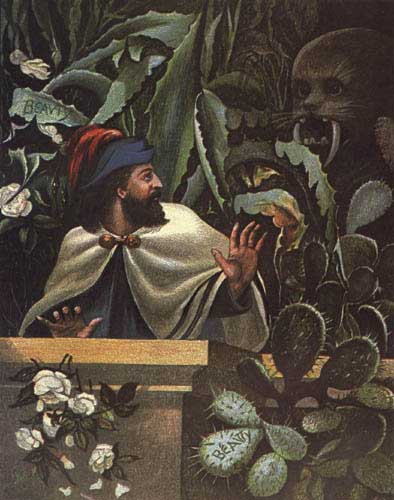
Walter Crane


All at once the merchant lost his whole fortune, excepting a small country house at a great distance from town, and told his children with tears in his eyes, they must go there and work for their living. The two eldest answered, that they would not leave the town, for they had several lovers, who they were sure would be glad to have them, though they had no fortune; but the good ladies were mistaken, for their lovers slighted and forsook them in their poverty. As they were not beloved on account of their pride, everybody said; they do not deserve to be pitied, we are very glad to see their pride humbled, let them go and give themselves quality airs in milking the cows and minding their dairy. But, added they, we are extremely concerned for Beauty, she was such a charming, sweet-tempered creature, spoke so kindly to poor people, and was of such an affable, obliging behavior. Nay, several gentlemen would have married her, though they knew she had not a penny; but she told them she could not think of leaving her poor father in his misfortunes, but was determined to go along with him into the country to comfort and attend him. Poor Beauty at first was sadly grieved at the loss of her fortune; "but," said she to herself, "were I to cry ever so much, that would not make things better, I must try to make myself happy without a fortune."

Arthur Rackham


When they came to their country house, the merchant and his three sons applied themselves to husbandry and tillage; and Beauty rose at four in the morning, and made haste to have the house clean, and dinner ready for the family. In the beginning she found it very difficult, for she had not been used to work as a servant, but in less than two months she grew stronger and healthier than ever. After she had done her work, she read, played on the harpsichord, or else sung whilst she spun.

On the contrary, her two sisters did not know how to spend their time; they got up at ten, and did nothing but saunter about the whole day, lamenting the loss of their fine clothes and acquaintance. "Do but see our youngest sister," said they, one to the other, "what a poor, stupid, mean-spirited creature she is, to be contented with such an unhappy dismal situation."

The good merchant was of quite a different opinion; he knew very well that Beauty outshone her sisters, in her person as well as her mind, and admired her humility and industry, but above all her humility and patience; for her sisters not only left her all the work of the house to do, but insulted her every moment.

Artist: ?


The family had lived about a year in this retirement, when the merchant received a letter with an account that a vessel, on board of which he had effects, was safely arrived. This news had liked to have turned the heads of the two eldest daughters, who immediately flattered themselves with the hopes of returning to town, for they were quite weary of a country life; and when they saw their father ready to set out, they begged of him to buy them new gowns, headdresses, ribbons, and all manner of trifles; but Beauty asked for nothing for she thought to herself, that all the money her father was going to receive, would scarce be sufficient to purchase everything her sisters wanted.

"What will you have, Beauty?" said her father.

"Since you have the goodness to think of me," answered she, "be so kind to bring me a rose, for as none grows hereabouts, they are a kind of rarity." Not that Beauty cared for a rose, but she asked for something, lest she should seem by her example to condemn her sisters' conduct, who would have said she did it only to look particular.

The good man went on his journey, but when he came there, they went to law with him about the merchandise, and after a great deal of trouble and pains to no purpose, he came back as poor as before.
He was within thirty miles of his own house, thinking on the pleasure he should have in seeing his children again, when going through a large forest he lost himself. It rained and snowed terribly; besides, the wind was so high, that it threw him twice off his horse, and night coming on, he began to apprehend being either starved to death with cold and hunger, or else devoured by the wolves, whom he heard howling all round him, when, on a sudden, looking through a long walk of trees, he saw a light at some distance, and going on a little farther perceived it came from a palace illuminated from top to bottom. The merchant returned God thanks for this happy discovery, and hastened to the place, but was greatly surprised at not meeting with any one in the outer courts. His horse followed him, and seeing a large stable open, went in, and finding both hay and oats, the poor beast, who was almost famished, fell to eating very heartily; the merchant tied him up to the manger, and walking towards the house, where he saw no one, but entering into a large hall, he found a good fire, and a table plentifully set out with but one cover laid. As he was wet quite through with the rain and snow, he drew near the fire to dry himself. "I hope," said he, "the master of the house, or his servants will excuse the liberty I take; I suppose it will not be long before some of them appear."

John Batten


He waited a considerable time, until it struck eleven, and still nobody came. At last he was so hungry that he could stay no longer, but took a chicken, and ate it in two mouthfuls, trembling all the while. After this he drank a few glasses of wine, and growing more courageous he went out of the hall, and crossed through several grand apartments with magnificent furniture, until he came into a chamber, which had an exceeding good bed in it, and as he was very much fatigued, and it was past midnight, he concluded it was best to shut the door, and go to bed.

It was ten the next morning before the merchant waked, and as he was going to rise he was astonished to see a good suit of clothes in the room of his own, which were quite spoiled; certainly, said he, this palace belongs to some kind fairy, who has seen and pitied my distress. He looked through a window, but instead of snow saw the most delightful arbors, interwoven with the beautifullest flowers that were ever beheld. He then returned to the great hall, where he had supped the night before, and found some chocolate ready made on a little table. "Thank you, good Madam Fairy," said he aloud, "for being so careful, as to provide me a breakfast; I am extremely obliged to you for all your favors."

The good man drank his chocolate, and then went to look for his horse, but passing through an arbor of roses he remembered Beauty's request to him, and gathered a branch on which were several; immediately he heard a great noise, and saw such a frightful Beast coming towards him, that he was ready to faint away.

"You are very ungrateful," said the Beast to him, in a terrible voice; "I have saved your life by receiving you into my castle, and, in return, you steal my roses, which I value beyond any thing in the universe, but you shall die for it; I give you but a quarter of an hour to prepare yourself, and say your prayers."

The merchant fell on his knees, and lifted up both his hands, "My lord," said he, "I beseech you to forgive me, indeed I had no intention to offend in gathering a rose for one of my daughters, who desired me to bring her one."

Artist: ??


"My name is not My Lord," replied the monster, "but Beast; I don't love compliments, not I. I like people to speak as they think; and so do not imagine, I am to be moved by any of your flattering speeches. But you say you have got daughters. I will forgive you, on condition that one of them come willingly, and suffer for you. Let me have no words, but go about your business, and swear that if your daughter refuse to die in your stead, you will return within three months."

The merchant had no mind to sacrifice his daughters to the ugly monster, but he thought, in obtaining this respite, he should have the satisfaction of seeing them once more, so he promised, upon oath, he would return, and the Beast told him he might set out when he pleased, "but," added he, "you shall not depart empty handed; go back to the room where you lay, and you will see a great empty chest; fill it with whatever you like best, and I will send it to your home," and at the same time Beast withdrew.

"Well," said the good man to himself, "if I must die, I shall have the comfort, at least, of leaving something to my poor children." He returned to the bedchamber, and finding a great quantity of broad pieces of gold, he filled the great chest the Beast had mentioned, locked it, and afterwards took his horse out of the stable, leaving the palace with as much grief as he had entered it with joy. The horse, of his own accord, took one of the roads of the forest, and in a few hours the good man was at home.

His children came round him, but instead of receiving their embraces with pleasure, he looked on them, and holding up the branch he had in his hands, he burst into tears. "Here, Beauty," said he, "take these roses, but little do you think how dear they are like to cost your unhappy father," and then related his fatal adventure. Immediately the two eldest set up lamentable outcries, and said all manner of ill-natured things to Beauty, who did not cry at all.

Eleanor Vere Boyle


"Do but see the pride of that little wretch," said they; "she would not ask for fine clothes, as we did; but no truly, Miss wanted to distinguish herself, so now she will be the death of our poor father, and yet she does not so much as shed a tear."

"Why should I," answered Beauty, "it would be very needless, for my father shall not suffer upon my account, since the monster will accept of one of his daughters, I will deliver myself up to all his fury, and I am very happy in thinking that my death will save my father's life, and be a proof of my tender love for him."

"No, sister," said her three brothers, "that shall not be, we will go find the monster, and either kill him, or perish in the attempt."

"Do not imagine any such thing, my sons," said the merchant, "Beast's power is so great, that I have no hopes of your overcoming him. I am charmed with Beauty's kind and generous offer, but I cannot yield to it. I am old, and have not long to live, so can only loose a few years, which I regret for your sakes alone, my dear children."

"Indeed father," said Beauty, "you shall not go to the palace without me, you cannot hinder me from following you." It was to no purpose all they could say. Beauty still insisted on setting out for the fine palace, and her sisters were delighted at it, for her virtue and amiable qualities made them envious and jealous.

The merchant was so afflicted at the thoughts of losing his daughter, that he had quite forgot the chest full of gold, but at night when he retired to rest, no sooner had he shut his chamber door, than, to his great astonishment, he found it by his bedside; he was determined, however, not to tell his children, that he was grown rich, because they would have wanted to return to town, and he was resolved not to leave the country; but he trusted Beauty with the secret, who informed him, that two gentlemen came in his absence, and courted her sisters; she begged her father to consent to their marriage, and give them fortunes, for she was so good, that she loved them and forgave heartily all their ill usage. These wicked creatures rubbed their eyes with an onion to force some tears when they parted with their sister, but her brothers were really concerned. Beauty was the only one who did not shed tears at parting, because she would not increase their uneasiness.

W. Heath Robinson


The horse took the direct road to the palace, and towards evening they perceived it illuminated as at first. The horse went of himself into the stable, and the good man and his daughter came into the great hall, where they found a table splendidly served up, and two covers. The merchant had no heart to eat, but Beauty, endeavoring to appear cheerful, sat down to table, and helped him. "Afterwards," thought she to herself, "Beast surely has a mind to fatten me before he eats me, since he provides such plentiful entertainment." When they had supped they heard a great noise, and the merchant, all in tears, bid his poor child, farewell, for he thought Beast was coming. Beauty was sadly terrified at his horrid form, but she took courage as well as she could, and the monster having asked her if she came willingly; "ye -- e -- es," said she, trembling.

The beast responded, "You are very good, and I am greatly obliged to you; honest man, go your ways tomorrow morning, but never think of coming here again."

"Farewell Beauty, farewell Beast," answered he, and immediately the monster withdrew. "Oh, daughter," said the merchant, embracing Beauty, "I am almost frightened to death, believe me, you had better go back, and let me stay here."

"No, father," said Beauty, in a resolute tone, "you shall set out tomorrow morning, and leave me to the care and protection of providence." They went to bed, and thought they should not close their eyes all night; but scarce were they laid down, than they fell fast asleep, and Beauty dreamed, a fine lady came, and said to her, "I am content, Beauty, with your good will, this good action of yours in giving up your own life to save your father's shall not go unrewarded." Beauty waked, and told her father her dream, and though it helped to comfort him a little, yet he could not help crying bitterly, when he took leave of his dear child.

As soon as he was gone, Beauty sat down in the great hall, and fell a crying likewise; but as she was mistress of a great deal of resolution, she recommended herself to God, and resolved not to be uneasy the little time she had to live; for she firmly believed Beast would eat her up that night.

Walter Crane 2


However, she thought she might as well walk about until then, and view this fine castle, which she could not help admiring; it was a delightful pleasant place, and she was extremely surprised at seeing a door, over which was written, "Beauty's Apartment." She opened it hastily, and was quite dazzled with the magnificence that reigned throughout; but what chiefly took up her attention, was a large library, a harpsichord, and several music books. "Well," said she to herself, "I see they will not let my time hang heavy upon my hands for want of amusement." Then she reflected, "Were I but to stay here a day, there would not have been all these preparations." This consideration inspired her with fresh courage; and opening the library she took a book, and read these words, in letters of gold:
Welcome Beauty, banish fear,
You are queen and mistress here.
Speak your wishes, speak your will,
Swift obedience meets them still.
"Alas," said she, with a sigh, "there is nothing I desire so much as to see my poor father, and know what he is doing." She had no sooner said this, when casting her eyes on a great looking glass, to her great amazement, she saw her own home, where her father arrived with a very dejected countenance. Her sisters went to meet him, and notwithstanding their endeavors to appear sorrowful, their joy, felt for having got rid of their sister, was visible in every feature. A moment after, everything disappeared, and Beauty's apprehensions at this proof of Beast's complaisance.

At noon she found dinner ready, and while at table, was entertained with an excellent concert of music, though without seeing anybody. But at night, as she was going to sit down to supper, she heard the noise Beast made, and could not help being sadly terrified. "Beauty," said the monster, "will you give me leave to see you sup?"

Arthur Rackham 2

"That is as you please," answered Beauty trembling.

"No," replied the Beast, "you alone are mistress here; you need only bid me gone, if my presence is troublesome, and I will immediately withdraw. But, tell me, do not you think me very ugly?"

"That is true," said Beauty, "for I cannot tell a lie, but I believe you are very good natured."

"So I am," said the monster, "but then, besides my ugliness, I have no sense; I know very well, that I am a poor, silly, stupid creature."

"'Tis no sign of folly to think so," replied Beauty, "for never did fool know this, or had so humble a conceit of his own understanding."

"Eat then, Beauty," said the monster, "and endeavor to amuse yourself in your palace, for everything here is yours, and I should be very uneasy, if you were not happy."

"You are very obliging," answered Beauty, "I own I am pleased with your kindness, and when I consider that, your deformity scarce appears."

"Yes, yes," said the Beast, "my heart is good, but still I am a monster."

"Among mankind," says Beauty, "there are many that deserve that name more than you, and I prefer you, just as you are, to those, who, under a human form, hide a treacherous, corrupt, and ungrateful heart."

"If I had sense enough," replied the Beast, "I would make a fine compliment to thank you, but I am so dull, that I can only say, I am greatly obliged to you."

Beauty ate a hearty supper, and had almost conquered her dread of the monster; but she had like to have fainted away, when he said to her, "Beauty, will you be my wife?"

AL Bowley

She was some time before she dared answer, for she was afraid of making him angry, if she refused. At last, however, she said trembling, "no Beast." Immediately the poor monster went to sigh, and hissed so frightfully, that the whole palace echoed. But Beauty soon recovered her fright, for Beast having said, in a mournful voice, "then farewell, Beauty," left the room; and only turned back, now and then, to look at her as he went out.

When Beauty was alone, she felt a great deal of compassion for poor Beast. "Alas," said she, "'tis thousand pities, anything so good natured should be so ugly."

Beauty spent three months very contentedly in the palace. Every evening Beast paid her a visit, and talked to her, during supper, very rationally, with plain good common sense, but never with what the world calls wit; and Beauty daily discovered some valuable qualifications in the monster, and seeing him often had so accustomed her to his deformity, that, far from dreading the time of his visit, she would often look on her watch to see when it would be nine, for the Beast never missed coming at that hour. There was but one thing that gave Beauty any concern, which was, that every night, before she went to bed, the monster always asked her, if she would be his wife. One day she said to him, "Beast, you make me very uneasy, I wish I could consent to marry you, but I am too sincere to make you believe that will ever happen; I shall always esteem you as a friend, endeavor to be satisfied with this."

"I must," said the Beast, "for, alas! I know too well my own misfortune, but then I love you with the tenderest affection. However, I ought to think myself happy, that you will stay here; promise me never to leave me."

Beauty blushed at these words; she had seen in her glass, that her father had pined himself sick for the loss of her, and she longed to see him again. "I could," answered she, "indeed, promise never to leave you entirely, but I have so great a desire to see my father, that I shall fret to death, if you refuse me that satisfaction."

Edmund Dulac


"I had rather die myself," said the monster, "than give you the least uneasiness. I will send you to your father, you shall remain with him, and poor Beast will die with grief."

"No," said Beauty, weeping, "I love you too well to be the cause of your death. I give you my promise to return in a week. You have shown me that my sisters are married, and my brothers gone to the army; only let me stay a week with my father, as he is alone."

"You shall be there tomorrow morning," said the Beast, "but remember your promise. You need only lay your ring on a table before you go to bed, when you have a mind to come back. Farewell Beauty." Beast sighed, as usual, bidding her good night, and Beauty went to bed very sad at seeing him so afflicted. When she waked the next morning, she found herself at her father's, and having rung a little bell, that was by her bedside, she saw the maid come, who, the moment she saw her, gave a loud shriek, at which the good man ran up stairs, and thought he should have died with joy to see his dear daughter again. He held her fast locked in his arms above a quarter of an hour. As soon as the first transports were over, Beauty began to think of rising, and was afraid she had no clothes to put on; but the maid told her, that she had just found, in the next room, a large trunk full of gowns, covered with gold and diamonds. Beauty thanked good Beast for his kind care, and taking one of the plainest of them, she intended to make a present of the others to her sisters. She scarce had said so when the trunk disappeared. Her father told her, that Beast insisted on her keeping them herself, and immediately both gowns and trunk came back again.

Beauty dressed herself, and in the meantime they sent to her sisters who hastened thither with their husbands.

They were both of them very unhappy. The eldest had married a gentleman, extremely handsome indeed, but so fond of his own person, that he was full of nothing but his own dear self, and neglected his wife. The second had married a man of wit, but he only made use of it to plague and torment everybody, and his wife most of all. Beauty's sisters sickened with envy, when they saw her dressed like a princess, and more beautiful than ever, nor could all her obliging affectionate behavior stifle their jealousy, which was ready to burst when she told them how happy she was. They went down into the garden to vent it in tears; and said one to the other, in what way is this little creature better than us, that she should be so much happier? "Sister," said the oldest, "a thought just strikes my mind; let us endeavor to detain her above a week, and perhaps the silly monster will be so enraged at her for breaking her word, that he will devour her."

"Right, sister," answered the other, "therefore we must show her as much kindness as possible." After they had taken this resolution, they went up, and behaved so affectionately to their sister, that poor Beauty wept for joy. When the week was expired, they cried and tore their hair, and seemed so sorry to part with her, that she promised to stay a week longer.

Jennie Harbour


In the meantime, Beauty could not help reflecting on herself, for the uneasiness she was likely to cause poor Beast, whom she sincerely loved, and really longed to see again. The tenth night she spent at her father's, she dreamed she was in the palace garden, and that she saw Beast extended on the grass plat, who seemed just expiring, and, in a dying voice, reproached her with her ingratitude. Beauty started out of her sleep, and bursting into tears. "Am I not very wicked," said she, "to act so unkindly to Beast, that has studied so much, to please me in everything? Is it his fault if he is so ugly, and has so little sense? He is kind and good, and that is sufficient. Why did I refuse to marry him? I should be happier with the monster than my sisters are with their husbands; it is neither wit, nor a fine person, in a husband, that makes a woman happy, but virtue, sweetness of temper, and complaisance, and Beast has all these valuable qualifications. It is true, I do not feel the tenderness of affection for him, but I find I have the highest gratitude, esteem, and friendship; I will not make him miserable, were I to be so ungrateful I should never forgive myself." Beauty having said this, rose, put her ring on the table, and then laid down again; scarce was she in bed before she fell asleep, and when she waked the next morning, she was overjoyed to find herself in the Beast's palace.

She put on one of her richest suits to please him, and waited for evening with the utmost impatience, at last the wished-for hour came, the clock struck nine, yet no Beast appeared. Beauty then feared she had been the cause of his death; she ran crying and wringing her hands all about the palace, like one in despair; after having sought for him everywhere, she recollected her dream, and flew to the canal in the garden, where she dreamed she saw him. There she found poor Beast stretched out, quite senseless, and, as she imagined, dead. She threw herself upon him without any dread, and finding his heart beat still, she fetched some water from the canal, and poured it on his head. Beast opened his eyes, and said to Beauty, "You forgot your promise, and I was so afflicted for having lost you, that I resolved to starve myself, but since I have the happiness of seeing you once more, I die satisfied."

"No, dear Beast," said Beauty, "you must not die. Live to be my husband; from this moment I give you my hand, and swear to be none but yours. Alas! I thought I had only a friendship for you, but the grief I now feel convinces me, that I cannot live without you." Beauty scarce had pronounced these words, when she saw the palace sparkle with light; and fireworks, instruments of music, everything seemed to give notice of some great event. But nothing could fix her attention; she turned to her dear Beast, for whom she trembled with fear; but how great was her surprise! Beast was disappeared, and she saw, at her feet, one of the loveliest princes that eye ever beheld; who returned her thanks for having put an end to the charm, under which he had so long resembled a Beast. Though this prince was worthy of all her attention, she could not forbear asking where Beast was.

"You see him at your feet, said the prince. A wicked fairy had condemned me to remain under that shape until a beautiful virgin should consent to marry me. The fairy likewise enjoined me to conceal my understanding. There was only you in the world generous enough to be won by the goodness of my temper, and in offering you my crown I can't discharge the obligations I have to you."

Beauty, agreeably surprised, gave the charming prince her hand to rise; they went together into the castle, and Beauty was overjoyed to find, in the great hall, her father and his whole family, whom the beautiful lady, that appeared to her in her dream, had conveyed thither.

"Beauty," said this lady, "come and receive the reward of your judicious choice; you have preferred virtue before either wit or beauty, and deserve to find a person in whom all these qualifications are united. You are going to be a great queen. I hope the throne will not lessen your virtue, or make you forget yourself. As to you, ladies," said the fairy to Beauty's two sisters, "I know your hearts, and all the malice they contain. Become two statues, but, under this transformation, still retain your reason. You shall stand before your sister's palace gate, and be it your punishment to behold her happiness; and it will not be in your power to return to your former state, until you own your faults, but I am very much afraid that you will always remain statues. Pride, anger, gluttony, and idleness are sometimes conquered, but the conversion of a malicious and envious mind is a kind of miracle."

Margaret Evans Price


Immediately the fairy gave a stroke with her wand, and in a moment all that were in the hall were transported into the prince's dominions. His subjects received him with joy. He married Beauty, and lived with her many years, and their happiness -- as it was founded on virtue -- was complete.

 Artists' names are under images.
SITE DESIGNED BY PRETTYWILDTHINGS